

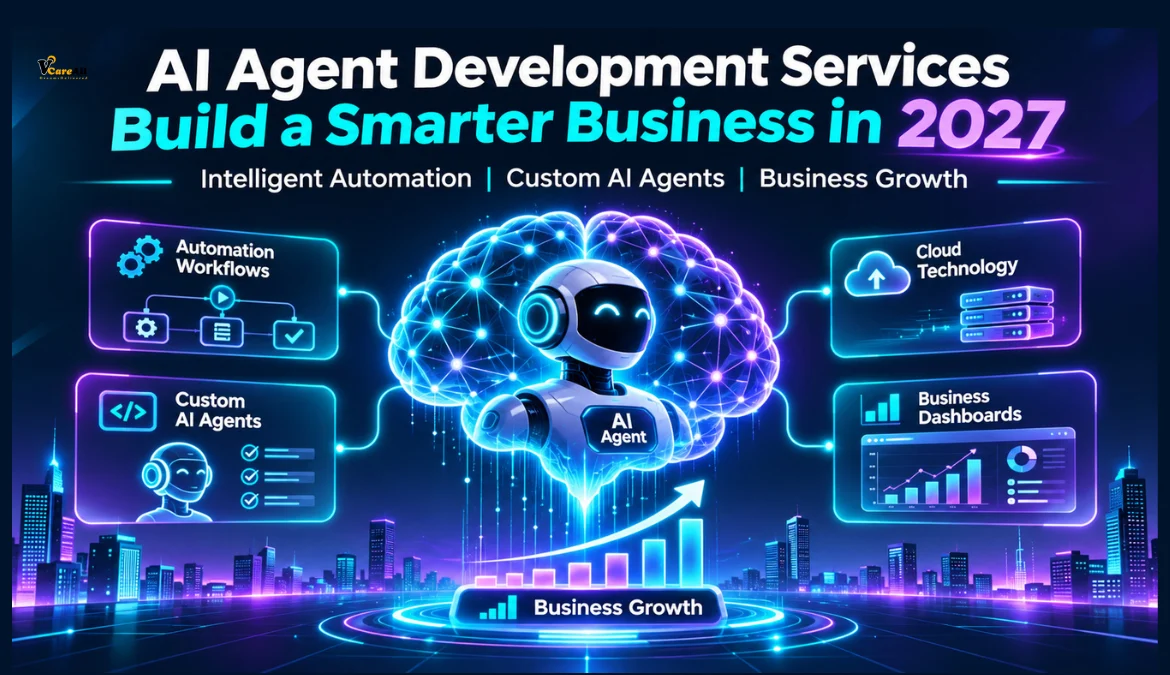
Imagine running a business where customer questions are answered instantly, important information is organized automatically, sales opportunities are identified faster, and repetitive tasks no longer consume your team’s valuable time.
Sounds like a dream? Artificial intelligence is bringing this vision closer to reality.
Businesses today face a common challenge: they want to grow faster, deliver exceptional customer experiences, and improve productivity without constantly increasing their workload. Traditional automation can handle simple, repetitive activities, but modern businesses often need something more intelligent.
This is where AI Agent Development Services are making a difference.
Unlike conventional software that follows fixed instructions, AI agents can understand goals, process information, interact with business applications, and take appropriate actions within defined boundaries. They can help businesses manage complicated workflows, support decision-making, and reduce unnecessary manual effort.
For example, imagine a potential customer visiting your website outside business hours. Instead of simply displaying a contact form, an AI agent could understand their requirements, answer relevant questions, identify a suitable service, and schedule a consultation with your team.
The result? A smoother customer experience and fewer missed opportunities.
As businesses prepare for 2027, interest in intelligent automation, custom AI agents, and AI-powered business solutions continues to create new possibilities.
But how do these systems actually work? What can they do for your organization? And how do you choose the right AI agent development company?
This comprehensive guide explains everything in simple language, from the fundamentals of AI agents to their benefits, business applications, development process, costs, and future opportunities.
Ready to Transform Your Business with AI Agents?
Discover how custom AI agents can simplify complex workflows and improve productivity.
Build smarter business operations with intelligent automation solutions.
What Are AI Agent Development Services?
AI agent development services involve designing, building, integrating, and maintaining intelligent software systems that can understand objectives, make context-based decisions, and perform tasks on behalf of users or businesses.
These services combine artificial intelligence, machine learning, large language models, application programming interfaces (APIs), and workflow automation.
The goal is to create intelligent digital assistants capable of handling more than basic conversations.
For example, a traditional chatbot might answer, “What are your business hours?”
An AI agent connected to approved business systems could check appointment availability, suggest suitable times, create a booking, and send a confirmation.
The difference lies in the ability to take action.
Professional AI agent development typically includes:
- Custom AI agent development: Building intelligent agents for specific business requirements.
- AI workflow automation: Automating repetitive and multi-step business activities.
- AI agent integration: Connecting agents with CRM platforms, databases, websites, and business applications.
- Enterprise AI solutions: Developing secure, scalable systems for larger organizations.
- Multi-agent AI systems: Creating multiple specialized agents that coordinate to complete tasks.
- AI agent maintenance: Monitoring performance, improving accuracy, and updating integrations.
These capabilities help organizations move beyond simple automation toward systems that can assist with more complex operational responsibilities.
How Do AI Agents Work?
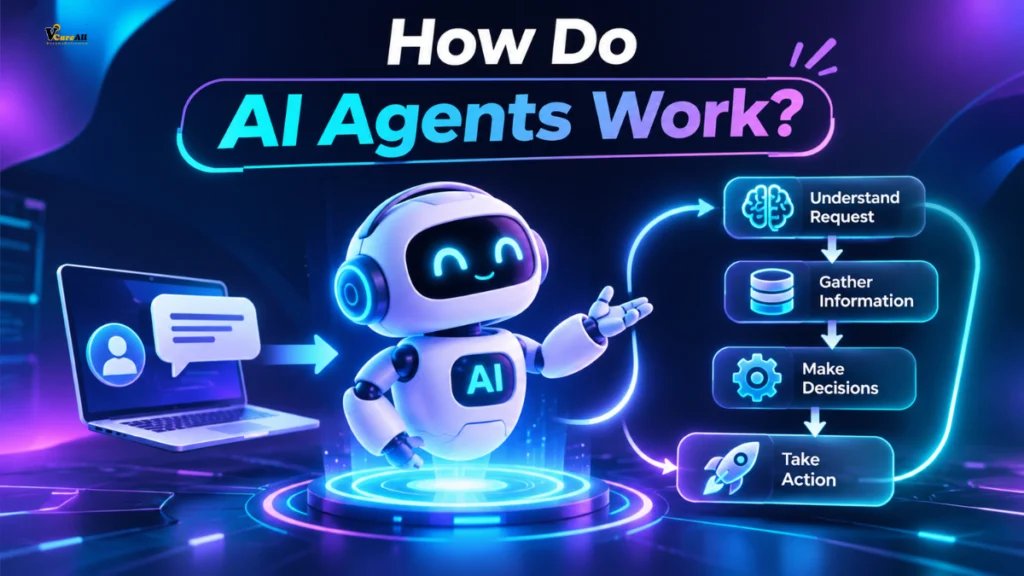
An AI agent works by combining language understanding, decision-making, information retrieval, and access to tools.
Instead of following only a rigid sequence, it can evaluate a request and determine the next appropriate step.
Consider a customer asking an online retailer:
“Where is my order, and can I change the delivery address?”
A properly designed AI agent could identify the customer’s order, retrieve shipping details, check whether address changes are still permitted, and guide the customer through the next step.
If the change requires approval, the agent can transfer the request to an authorized employee.
Understanding the User’s Request
The process begins when an AI agent receives a message, command, or business event.
Natural language processing and modern language models help interpret the user’s objective, even when the request is written conversationally.
Gathering Relevant Information
The agent retrieves information from connected sources such as knowledge bases, databases, customer records, or approved business applications.
This allows it to respond using relevant organizational information instead of relying entirely on general knowledge.
Choosing the Next Action
Based on the available information and instructions, the agent selects an appropriate task.
It might search for a document, update a permitted record, prepare a report, or ask for clarification.
Executing Tasks Through Tools
AI agents use authorized tools and APIs to interact with other systems.
For example, an agent may create a support ticket or prepare an email draft.
Sensitive actions, such as issuing refunds or changing financial records, should require suitable validation and approval.
Reviewing Results
A well-designed agent checks whether the action succeeded, handles errors, and determines whether additional steps are necessary.
This approach makes intelligent automation more flexible while maintaining appropriate human oversight.
AI Agents vs Traditional Chatbots vs Automation Tools
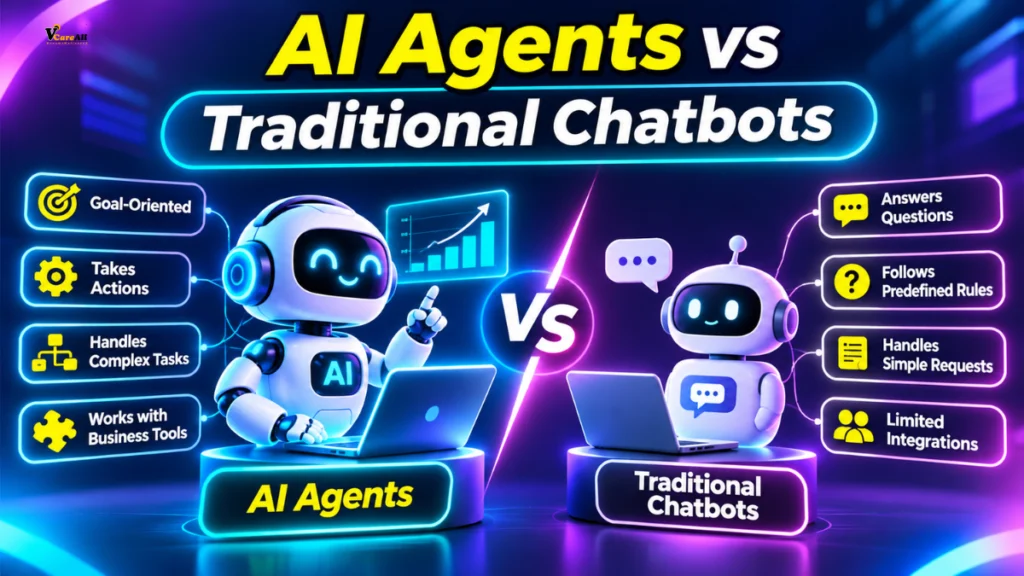
Although these technologies are related, they serve different purposes.
Understanding their differences helps businesses choose the right solution.
| Feature | Traditional Chatbots | Automation Tools | AI Agents |
|---|---|---|---|
| Primary purpose | Answer questions | Execute predefined tasks | Work toward specific goals |
| Decision-making | Usually limited | Rule-based | Context-based within limits |
| Natural language understanding | Basic to advanced | Usually limited | Advanced |
| Workflow flexibility | Limited | Mostly predefined | Can adapt to changing conditions |
| External integrations | Sometimes available | Common | Important for taking actions |
| Multi-step tasks | Limited | Fixed workflows | Can coordinate dynamic workflows |
| Best suited for | Basic customer support | Repetitive processes | Complex, variable business tasks |
For instance, a basic automation tool might send a follow-up email whenever someone fills out a form.
An AI agent could first review the inquiry, identify the customer’s interests, categorize the lead, prepare a personalized response, and recommend an appropriate next action.
However, AI agents are not automatically better for every situation.
When a task follows simple, predictable rules, traditional automation may be cheaper, faster, and easier to maintain.
The most effective solution is the one that matches the complexity of your business requirements.
Unlock the Power of Intelligent Automation
Reduce repetitive tasks and give your team more time to focus on business growth.
Explore AI agent development services tailored to your unique requirements.
Why Businesses Are Investing in AI Agent Development Services
Organizations increasingly want technology that improves efficiency while supporting better business decisions.
Custom AI agents offer opportunities to achieve both.
Improved Operational Efficiency
Employees often spend significant time copying information, preparing routine reports, updating records, and responding to repetitive requests.
AI agents can assist with these activities, allowing employees to concentrate on strategic and customer-focused responsibilities.
For example, an internal operations agent could gather information from approved sources and prepare a daily status summary.
Better Customer Experiences
Customers appreciate quick answers, clear communication, and convenient service.
AI-powered support agents can provide assistance outside normal business hours and direct complicated issues to human representatives.
This can reduce customer frustration and improve service consistency.
Reduced Manual Workload
Repetitive administrative tasks consume valuable resources.
AI agents can organize incoming requests, prepare documents, classify information, and coordinate routine workflows.
The potential savings depend on task volume, implementation quality, and ongoing operating costs.
More Consistent Business Processes
Manual work can lead to missed steps or inconsistent procedures.
Agents built with clear instructions, validation rules, and approval checkpoints can support more standardized operations.
They still require monitoring because AI-generated outputs are not always accurate.
Improved Business Intelligence
Businesses collect information from websites, customer interactions, sales platforms, and internal systems.
AI agents can help summarize these records, identify patterns, and make relevant information easier to understand.
For example, a sales analysis agent could highlight changes in customer inquiries or explain differences between monthly performance reports.
Flexible Business Growth
As an organization grows, its operational requirements become more complex.
Well-architected AI solutions can be expanded to support additional workflows, departments, and integrations.
This makes scalability an important consideration during development.
Types of AI Agents Businesses Can Develop
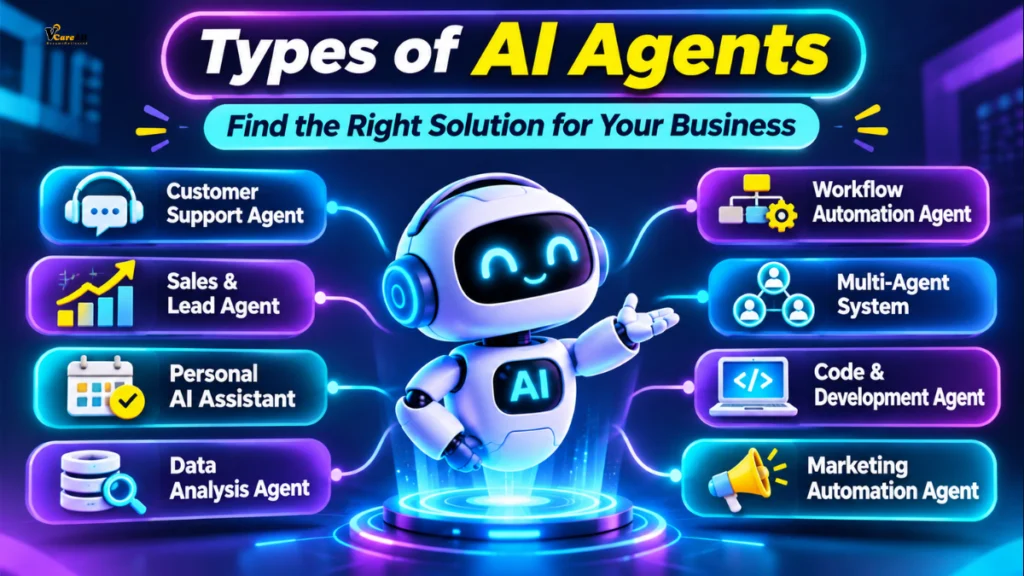
Different business challenges require different types of intelligent agents.
A professional development team should recommend the appropriate architecture rather than treating every project as an identical solution.
Customer Support AI Agents
Customer support agents answer frequently asked questions, retrieve relevant information, assist with common service requests, and escalate complicated cases.
They can be integrated into websites, applications, and supported messaging channels.
Sales and Lead Qualification Agents
Sales agents help businesses manage incoming inquiries and identify promising opportunities.
They may ask qualifying questions, organize lead information, update CRM records, and schedule meetings.
These agents can support sales representatives without replacing the relationship-building skills required for complex negotiations.
Personal AI Assistants
Personal AI assistants help individuals organize activities, search information, prepare documents, and manage permitted tasks.
Businesses can customize these assistants to support employees, executives, or specific departments.
Data Analysis Agents
Data analysis agents retrieve business information, summarize reports, and explain performance trends.
They can help decision-makers understand data without manually searching through several dashboards.
However, important financial and operational conclusions should be verified against the underlying records.
Workflow Automation Agents
Workflow agents coordinate activities across connected software systems.
For example, an agent might review a submitted form, validate required information, create a CRM entry, and notify the appropriate department.
Multi-Agent AI Systems
Multi-agent AI systems consist of specialized agents that collaborate on a larger objective.
One agent might research information, another might analyze it, and another might prepare a report.
A coordinating system manages the overall workflow and determines when human approval is required.
These systems can be useful for complex tasks, although they also introduce additional development and monitoring requirements.
Custom AI Agent Development Services for Different Industries
AI agents are not limited to technology companies.
Organizations across multiple industries can use intelligent automation to improve specific business processes.
| Industry | Potential AI Agent Application | Business Value |
|---|---|---|
| E-commerce | Order tracking and product assistance | Convenient customer support |
| Healthcare | Appointment scheduling and administrative support | Reduced administrative workload |
| Banking and finance | Document collection and inquiry routing | More efficient operations |
| Education | Course guidance and student support | Easier access to information |
| Real estate | Property inquiry handling and scheduling | Faster lead management |
| Manufacturing | Maintenance reporting and documentation | Better operational coordination |
| Human resources | Employee onboarding and policy assistance | Streamlined administration |
| Digital marketing | Campaign reporting and lead organization | Improved workflow efficiency |
| Travel and hospitality | Booking assistance and itinerary preparation | Better service convenience |
| Logistics | Shipment status inquiries and exception reporting | Improved operational visibility |
AI Agents in Healthcare
Healthcare organizations can use AI agents for appointment coordination, administrative inquiries, and document processing.
Clinical recommendations and patient-sensitive actions require much stricter controls, privacy safeguards, and qualified professional oversight.
AI Agents in E-Commerce
Online retailers can build agents to support product discovery, order inquiries, return eligibility checks, and customer communication.
Integrating these agents with accurate inventory and order systems is essential.
AI Agents in Digital Marketing
Marketing teams can benefit from agents that organize campaign data, summarize performance, prepare content drafts, and assist with customer segmentation.
For example, an AI marketing agent could retrieve approved advertising metrics and produce a weekly campaign summary for review.
AI Agents in Education
Educational institutions can develop assistants that explain course information, guide applicants through admission requirements, and answer administrative questions.
Important eligibility information should come from verified institutional sources.
The common principle across all industries is simple: AI agents become valuable when they solve a clearly defined business problem.
What Is the AI Agent Development Process?
Successful AI agent development requires more than selecting a language model and connecting it to a website.
It involves careful planning, secure integration, testing, and continuous improvement.
Business Requirement Analysis
Development begins by understanding the organization’s challenges.
The development team identifies repetitive processes, expected outcomes, users, available information, and operational limitations.
This stage also determines whether an AI agent is necessary or whether conventional automation would be more effective.
Defining Agent Responsibilities
The next step involves specifying what the agent is allowed to do.
For example, a customer support agent may be permitted to retrieve order status but not independently issue high-value refunds.
Clear responsibilities reduce unnecessary risk.
Selecting the Technology Stack
Developers select suitable language models, databases, orchestration frameworks, APIs, and hosting environments.
The choice depends on performance requirements, security expectations, integration needs, and budget.
Designing the Agent Architecture
The architecture defines how the agent receives instructions, accesses information, selects tools, and manages tasks.
Simple projects may require a single agent, while complex workflows may benefit from several specialized components.
Integrating Business Applications
The agent is connected to approved systems such as CRM software, support platforms, document repositories, or internal applications.
Integration enables the agent to work with relevant business information and perform permitted actions.
Testing and Quality Assurance
Before deployment, developers test the agent using realistic business scenarios.
Testing should evaluate accuracy, task completion, tool permissions, error recovery, security, latency, and appropriate escalation.
Deployment and Continuous Monitoring
Once the system meets acceptance criteria, it can be deployed to the intended environment.
Teams should continue monitoring its performance, reviewing failures, updating instructions, and improving integrations as business requirements change.
An AI agent is not simply a one-time development project. It is a software system that requires ongoing management.
Build Custom AI Agents That Work for You
Your business is unique, and your AI solutions should be too.
Develop intelligent AI agents that align with your goals and existing systems.
Technologies Used in AI Agent Development
Several technologies work together to make intelligent AI agents practical.
Large Language Models
Large language models help agents interpret instructions, understand context, generate responses, and select actions.
Different models offer different combinations of capabilities, speed, cost, and deployment options.
Natural Language Processing
Natural language processing enables computers to interpret human language.
It helps agents understand messages, extract important information, and respond conversationally.
Retrieval-Augmented Generation
Retrieval-augmented generation, commonly called RAG, allows AI systems to retrieve relevant information from external knowledge sources before generating a response.
This approach is useful when agents need access to business policies, product documents, or frequently updated information.
Retrieval improves access to relevant context but does not guarantee factual accuracy.
APIs and Tool Calling
APIs allow agents to interact with business applications.
Tool calling provides a structured way to request information or perform authorized operations.
Agent Orchestration Frameworks
Frameworks such as LangGraph, the OpenAI Agents SDK, and other agent-development tools can help developers organize tasks, maintain workflow state, and coordinate agent activities.
Framework selection should be based on project requirements rather than popularity alone.
Databases and Memory Systems
Databases store business records, application data, and operational information.
Where appropriate, memory systems help agents preserve useful context across tasks.
Sensitive information should be stored only when necessary and protected by suitable access controls.
Security and Monitoring Tools
Logging, tracing, identity management, permission controls, and automated evaluations help teams understand how agents behave.
These technologies are essential for maintaining reliable enterprise AI solutions.
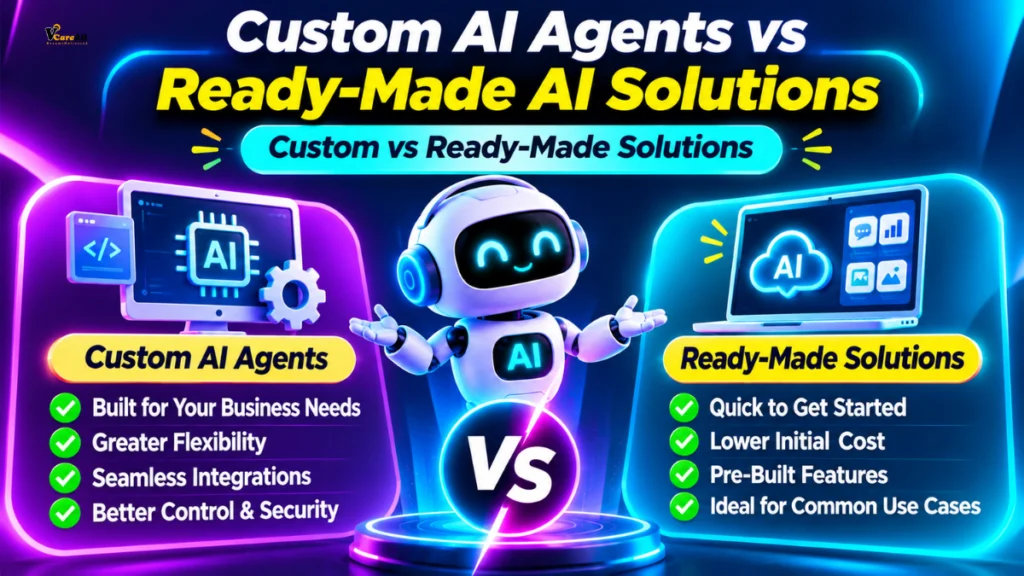
Benefits of Custom AI Agents Over Ready-Made Solutions
Businesses often face an important decision: purchase an existing AI tool or invest in custom AI agent development.
Ready-made solutions can be suitable for standard business requirements.
However, organizations with specialized workflows may need greater flexibility.
| Factor | Ready-Made AI Tools | Custom AI Agents |
|---|---|---|
| Initial implementation | Usually faster | Requires development |
| Customization | Limited by available features | Designed around business needs |
| Integration | Depends on supported connectors | Can include tailored integrations |
| Initial cost | Often lower | Usually higher |
| Maintenance | Often managed by the vendor | Requires an agreed support model |
| Workflow control | Product-dependent | Greater design flexibility |
| Data governance | Depends on provider controls | Can be tailored to requirements |
| Scalability | Depends on plan and architecture | Depends on custom architecture |
Custom agents are particularly useful when businesses need specialized processes, unique integrations, or control over how tasks are executed.
For example, a logistics company may require an agent that works with its internal shipment database, reporting tools, and customer service platform.
A general-purpose assistant might not support those workflows without additional development.
However, customization also introduces responsibilities involving testing, infrastructure, maintenance, and security.
Businesses should evaluate the total cost of ownership before making a decision.
How Much Does AI Agent Development Cost?
One of the most common questions businesses ask is how much it costs to develop an AI agent.
There is no universal price.
The cost of AI agent development depends on the project’s complexity, technical requirements, security controls, and integration needs.
A basic knowledge assistant is generally less complicated than an enterprise system that coordinates multiple applications and performs sensitive operations.
Factors Affecting Development Cost
Project complexity: More complicated workflows require additional design, development, and testing.
Integrations: Connecting multiple applications can increase development effort, particularly when systems have limited APIs.
Model usage: AI model providers may charge based on usage, which contributes to ongoing operating expenses.
Data preparation: Organizing, cleaning, and securing business information can require substantial work.
Security requirements: Authentication, access permissions, audit logging, and approval mechanisms add important implementation responsibilities.
Scalability: Systems designed for high request volumes may need additional infrastructure.
Maintenance: Updates, performance monitoring, troubleshooting, and ongoing evaluation contribute to long-term costs.
Understanding Different Project Complexities
| Project Type | Typical Requirements | Relative Complexity |
|---|---|---|
| Basic information agent | Knowledge retrieval and straightforward responses | Low |
| Customer support agent | Knowledge base, support integration, escalation | Low to medium |
| Sales automation agent | CRM connection, lead qualification, scheduling | Medium |
| Workflow automation agent | Multiple APIs, validation, task coordination | Medium to high |
| Enterprise multi-agent platform | Complex orchestration, security, monitoring | High |
These categories are illustrative, not fixed price brackets.
For an accurate estimate, businesses should request a proposal that separates development costs from recurring model usage, hosting, support, and maintenance expenses.
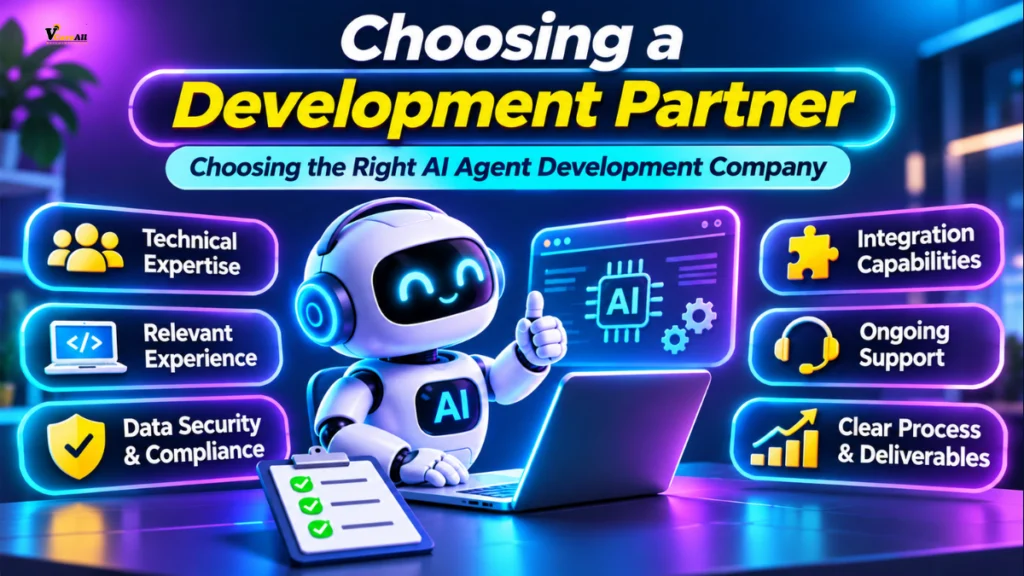
How to Choose the Right AI Agent Development Company
Selecting the right development partner is one of the most important decisions in an AI project.
An experienced company should understand both the technology and the business problem.
Evaluate Technical Expertise
Look for practical experience with AI models, APIs, software architecture, databases, automation, and production deployments.
Ask how the team handles tool failures, inaccurate responses, and system monitoring.
Understand Their Development Approach
A reliable partner should begin by discussing your business objectives.
Be cautious of providers who recommend complicated multi-agent systems before understanding the task.
Review Relevant Project Experience
Ask for demonstrations, case studies, or technical examples where available.
Focus on evidence of useful outcomes rather than impressive terminology.
Discuss Data Security
Understand how business information will be handled, stored, accessed, and protected.
Ask about authentication, data retention, permissions, and third-party services.
Confirm Integration Capabilities
Make sure the team can work with your existing applications and infrastructure.
Successful AI agent integration should improve your current workflow rather than unnecessarily complicate it.
Ask About Maintenance and Support
An AI agent may require updates as models, software integrations, and business policies change.
Clarify who will monitor performance, resolve technical issues, and maintain the solution.
Request Clear Project Deliverables
Before development begins, agree on the project scope, expected functionality, testing approach, acceptance criteria, and ongoing costs.
Transparent communication helps prevent misunderstandings and unnecessary expenses.
Common Challenges in AI Agent Development
Although intelligent agents offer significant opportunities, development is not without challenges.
Understanding these limitations helps businesses make responsible decisions.
Incorrect or Misleading Responses
AI models can generate inaccurate information.
Developers should use reliable data sources, validation procedures, and appropriate human review.
Data Privacy and Security
Agents may interact with sensitive business information.
Strong permissions, data minimization, secure integrations, and compliance reviews are important.
Integration Difficulties
Older software systems may not provide convenient APIs.
Custom connectors or workflow redesign may be necessary.
Unexpected Operating Costs
Complex agent workflows can involve multiple model calls and external services.
Monitoring usage and optimizing task execution helps manage expenses.
Uncontrolled Actions
Agents should never receive broader system permissions than necessary.
Important actions may require explicit authorization, and high-risk operations should have clear escalation procedures.
Maintaining Consistent Performance
An agent that works well during initial demonstrations may encounter unfamiliar situations in real business environments.
Continuous testing and evaluation are necessary to maintain reliability.
The goal should not be complete autonomy at any cost. It should be dependable automation with appropriate controls.
How to Measure the Success of AI Agents
Implementing an AI agent is only the beginning.
Businesses also need to understand whether the investment produces meaningful results.
The best performance indicators depend on the agent’s responsibilities.
| Performance Metric | What It Measures | Why It Matters |
|---|---|---|
| Task completion rate | Percentage of assigned tasks completed correctly | Evaluates effectiveness |
| Response accuracy | Quality and factual correctness of responses | Supports reliability |
| Average handling time | Time required to complete a request | Measures efficiency |
| Escalation rate | Requests transferred to human teams | Reveals automation boundaries |
| Cost per completed task | Operational expense per successful task | Helps assess financial value |
| Customer satisfaction | User feedback on agent interactions | Indicates service quality |
| Error rate | Frequency of failed or incorrect actions | Identifies improvement needs |
| Employee time saved | Reduction in manual processing time | Shows productivity impact |
Businesses should establish baseline measurements before deployment.
For example, if employees previously spent several hours per week preparing routine reports, the organization can compare that workload against the agent-supported process.
However, time savings should not be considered in isolation.
The cost of the agent, human review, error correction, and ongoing maintenance must also be included.
A successful AI implementation produces measurable value without introducing unacceptable operational risk.
Make Your Business Smarter with AI Technology
Turn everyday business challenges into opportunities for greater efficiency.
Discover scalable AI solutions designed to support your growing operations.
Best Practices for Successful AI Agent Implementation
Businesses can improve the chances of a successful project by following a practical implementation strategy.
Start with a specific problem. Identify one workflow where the expected benefit can be measured clearly.
Choose the simplest effective solution. Not every task requires an autonomous agent or multiple collaborating agents.
Use reliable business data. Provide access to accurate, relevant, and approved information sources.
Define clear permissions. Limit the actions and information available to each agent.
Keep humans involved when necessary. Introduce approval checkpoints for sensitive or irreversible actions.
Test realistic scenarios. Evaluate normal requests, unexpected inputs, missing information, and integration failures.
Monitor performance continuously. Use logs, evaluations, and business metrics to identify weaknesses.
Expand gradually. Once an initial use case demonstrates value, consider additional workflows.
This approach allows organizations to learn from practical experience instead of making a large investment based entirely on expectations.
Future of AI Agent Development Services in 2027
As businesses approach 2027, AI agent technology is expected to remain an important area of software development and business automation.
Several developments are likely to influence how organizations evaluate and deploy these systems.
Greater Adoption of Specialized AI Agents
Organizations may increasingly prefer agents designed for specific responsibilities rather than expecting one general-purpose system to perform every task.
Specialized agents can make responsibilities, testing, and permissions easier to define.
More Connected Business Workflows
AI agents are likely to become more closely integrated with CRM platforms, enterprise applications, document management systems, and communication tools.
Better connectivity can help businesses reduce manual transitions between applications.
Growing Interest in Multi-Agent Collaboration
More organizations may experiment with specialized agents that coordinate research, analysis, reporting, and operational tasks.
However, multi-agent systems will still need to demonstrate advantages over simpler workflows.
Increased Emphasis on Responsible AI
As agents gain access to business tools, organizations will need stronger security, accountability, evaluation, and approval procedures.
Reliability and governance are likely to become important factors in selecting development partners.
More Personalized Digital Experiences
With appropriate permissions and access to relevant information, agents may deliver more personalized assistance to customers and employees.
Privacy and transparency will remain essential considerations.
Better Evaluation of Business Value
Organizations are likely to place greater emphasis on measurable outcomes instead of adopting AI simply because it is new.
Cost per task, accuracy, productivity, and customer satisfaction will help determine whether deployments should be expanded.
These are forward-looking expectations rather than guaranteed developments. The pace of adoption will depend on technical progress, business requirements, cost, and regulatory considerations.
Why AI Agent Development Is Becoming an Important Business Strategy
AI agent development is not simply about introducing another software tool.
It represents an opportunity to reconsider how routine business processes are organized and executed.
For many companies, the challenge is not a lack of technology. It is the time employees spend moving information between systems, managing repetitive activities, and searching for answers.
Intelligent agents can help address some of these inefficiencies.
A small business may begin with an AI-powered customer inquiry assistant.
A growing company might implement an agent that organizes sales leads and prepares internal reports.
A large enterprise may explore connected systems that coordinate approved workflows across several departments.
These organizations have different budgets and requirements, but they share a common objective: making business operations more efficient.
The strongest AI strategy begins with business needs, not technology hype.
When the problem is clear, development teams can determine whether an AI agent is the right solution and build a system around measurable results.
Automate Repetitive Tasks and Focus on Growth
Stop spending valuable time on manual processes that slow down your team.
Let AI-powered agents support routine tasks and streamline workflows.
Conclusion: Build a Smarter Business with AI Agent Development Services
Artificial intelligence is changing the way businesses approach automation, productivity, and customer interactions.
Instead of relying exclusively on fixed processes and repetitive manual activities, organizations can explore intelligent systems that understand objectives, access relevant information, and assist with meaningful tasks.
From customer support and sales automation to enterprise workflows and business reporting, AI Agent Development Services offer opportunities to create more efficient and connected operations.
However, successful implementation requires a thoughtful approach.
Businesses should identify clear objectives, evaluate the right technology, prioritize security, and measure actual performance before expanding their investments.
The future of business automation is not about replacing every human decision with artificial intelligence. It is about combining intelligent technology with human expertise to produce better outcomes.
As you plan your technology strategy for 2027, consider which repetitive workflows, customer service challenges, or information management tasks could benefit from intelligent automation.
Ready to explore custom AI agents for your business?
Start by identifying your most time-consuming processes and discussing your requirements with an experienced AI development team. The right solution can help you build a more efficient, responsive, and scalable business.
Frequently Asked Questions About AI Agent Development Services
What are AI Agent Development Services?
AI agent development services involve creating intelligent software agents that can understand instructions, retrieve information, make context-based decisions, and perform authorized tasks. These services may include consulting, custom development, integrations, testing, deployment, and ongoing maintenance.
How are AI agents different from chatbots?
Traditional chatbots primarily provide conversational responses, while AI agents can also interact with external tools and execute multi-step workflows. Some advanced chatbots include agent capabilities, so the distinction depends on what the system can actually do.
Can AI agents automate business processes?
Yes. AI agents can assist with customer inquiries, lead qualification, data organization, report preparation, and other business workflows. The level of automation depends on system integrations, permissions, task complexity, and reliability requirements.
How much does custom AI agent development cost?
Development costs vary according to complexity, integrations, security requirements, infrastructure, and ongoing model usage. A basic assistant generally requires less development effort than an enterprise system with multiple agents and specialized workflows.
How long does it take to develop an AI agent?
The development timeline depends on the scope of the project. A limited proof of concept may require relatively little implementation time, while production-ready enterprise systems can take substantially longer because of integrations, testing, security, and approvals.
Which industries benefit from AI agents?
E-commerce, healthcare administration, finance, education, real estate, manufacturing, logistics, digital marketing, and customer service are among the industries that can benefit from suitable AI agent applications.
Are AI agents safe for business use?
AI agents can be deployed with security controls, limited permissions, monitoring, and human approval mechanisms. However, no system is completely risk-free. Sensitive applications require careful testing, governance, and ongoing oversight.
What technologies are used to develop AI agents?
Common technologies include large language models, natural language processing, retrieval-augmented generation, APIs, databases, orchestration frameworks, and monitoring tools. The technology stack depends on the project’s requirements.
Can AI agents integrate with existing business software?
Yes. Custom AI agents can integrate with websites, CRM systems, help desks, databases, and other business applications when suitable interfaces and permissions are available. Some legacy platforms may require additional development.
Why should a business hire an AI agent development company?
An experienced development company can help assess business requirements, select appropriate technologies, build integrations, implement security controls, and maintain the system. Professional assistance is especially valuable for complex or business-critical applications.
