


Imagine earning a commission online without convincing someone to buy an expensive product. Sounds interesting, right?
What if you could get paid when someone signs up for a free trial, registers for a service, or downloads an app?
That’s where CPA affiliate marketing comes into the picture.
Most people think affiliate marketing is all about selling products. They imagine sharing product links, asking people to make purchases, and waiting for commissions. But there’s another side of affiliate marketing that many beginners don’t know about.
And the good news? You don’t always need to make a sale to earn a commission.
If you’ve been searching for what is CPA affiliate marketing, how it works, and whether it’s a good opportunity for beginners, you’re in the right place.
CPA marketing is a performance-based marketing model where you can earn commissions when people complete specific actions through your promotional efforts.
These actions might include filling out a form, signing up for a newsletter, requesting a quote, or making a purchase.
But here’s something important.
CPA affiliate marketing isn’t a shortcut to instant money. Just like any online business, it requires the right strategy, useful content, a relevant audience, and consistent effort.
The exciting part is that you don’t necessarily need a huge budget, thousands of followers, or years of marketing experience to start learning.
In this guide, we’ll explore how CPA affiliate marketing works, its benefits, different commission models, the mistakes beginners should avoid, and seven powerful tips that can help you build a stronger foundation.
Ready to understand how it all works? Let’s get started.
Ready to Start Your CPA Marketing Journey?
Discover how CPA marketing works and explore beginner-friendly opportunities.
Take your first step toward building practical affiliate marketing skills.
What Is CPA Affiliate Marketing?
CPA stands for Cost Per Action, although some marketing programs also use CPA to mean Cost Per Acquisition.
CPA affiliate marketing is a type of performance-based marketing in which an affiliate earns a commission when a referred visitor completes a particular action required by an advertiser.
Instead of receiving payment simply because someone views an advertisement or clicks a link, you earn money when the visitor completes a qualifying action.
That action depends on the offer you’re promoting.
For example, a company might want people to register for its online learning platform. Rather than paying affiliates only when someone buys a course, it may offer a commission for every verified registration.
You promote that offer through your website, blog, social media, or another approved marketing channel.
When someone uses your affiliate link and completes the registration, you may earn a commission.
Pretty simple to understand, isn’t it?
The important thing to remember is that not every CPA offer requires a purchase. However, some do, and every offer has its own conditions for earning a payout.
A Simple Example of CPA Affiliate Marketing
Imagine you’re running a blog about productivity tools.
You join an affiliate program offering a hypothetical $4 commission for every approved free-trial signup.
You write a helpful article about productivity apps and include your unique affiliate link.
Here’s what happens:
- A visitor reads your article.
- They click your affiliate link.
- They reach the advertiser’s website.
- They register for the free trial.
- The advertiser verifies the registration.
- You receive a $4 commission if the action qualifies.
Now imagine 50 people complete approved registrations.
Your potential commission would be:
50 approved registrations × $4 = $200
This is only an illustration, not an earnings prediction. Real commission rates, approval rules, conversion rates, and payment conditions vary between advertisers.
The main idea is simple: you help a business achieve a specific marketing goal, and the business rewards you for qualified results.

How Does CPA Affiliate Marketing Work?
Understanding what is CPA affiliate marketing becomes much easier when you know who is involved and how the process works.
There are usually three main parties in a CPA marketing campaign.
The Advertiser
The advertiser is the business that wants a particular result.
It could be a software company looking for free-trial users, an educational platform seeking registrations, or an insurance provider collecting quote requests.
Advertisers create offers and decide which actions count as successful conversions.
They also set the commission amount and campaign conditions.
The Affiliate
The affiliate, sometimes called the publisher, is the person or business promoting the advertiser’s offer.
As an affiliate, your job is to introduce the right audience to the offer through useful, accurate, and relevant content.
You might use SEO articles, videos, newsletters, social media posts, or paid advertising where permitted.
Your commission depends on the qualifying actions generated through your tracking link.
The CPA Network
A CPA network connects advertisers with affiliates.
Some advertisers manage affiliate programs directly, while others work with networks.
Networks may provide available offers, tracking tools, reporting dashboards, campaign rules, and payment services.
They can also review affiliate applications and verify whether conversions meet the advertiser’s requirements.
Here’s a quick overview.
| Participant | Main Responsibility | Main Benefit |
|---|---|---|
| Advertiser | Creates an offer and defines the action | Gains qualified customers or leads |
| Affiliate | Promotes the offer to relevant audiences | Earns approved commissions |
| CPA Network | Connects parties and supports tracking | Earns network fees or an agreed share |
| Visitor | Explores the offer and chooses whether to act | Receives a relevant product, service, or opportunity |
The Complete CPA Marketing Process
The process generally begins when an affiliate joins a network or an advertiser’s program.
After approval, the affiliate chooses an offer suitable for their audience.
The network or advertiser provides a unique tracking link.
The affiliate then promotes the offer using approved traffic sources.
When someone clicks the link and completes the required action, the tracking system records the event.
The advertiser or network checks whether the action meets the offer’s conditions.
Once verified, the conversion becomes eligible for payment under the program’s payout schedule.
Keep in mind that a recorded conversion isn’t always an approved conversion. Duplicate leads, invalid information, restricted traffic, and other rule violations may result in rejection.
Why Is CPA Affiliate Marketing Popular Among Beginners?
One reason beginners explore CPA marketing is that it offers different ways to earn commissions.
Traditional product affiliate programs often focus on completed purchases. CPA programs can also reward other valuable customer actions.
This gives affiliates the opportunity to work with different industries and audiences.
You Don’t Always Need to Sell a Product
Selling a product can require considerable trust and buying intent.
However, some CPA offers involve actions such as signing up for a free account or requesting information.
These actions may be easier for certain audiences to consider than making an immediate purchase.
Of course, an easier action doesn’t automatically mean more profit. Offer quality, visitor intent, approval rates, and traffic costs still matter.
You Can Explore Different Niches
CPA marketing isn’t limited to one industry.
You can find programs connected with software, education, mobile applications, business services, ecommerce, and other areas.
This flexibility allows you to focus on topics you understand and audiences you want to help.
You Can Begin With Organic Traffic
Some CPA programs permit promotion through blogs, search engines, videos, and social platforms.
That means beginners can start by creating useful content rather than immediately investing in paid advertisements.
However, organic traffic takes time to develop, and you still need to follow each program’s promotional rules.
You Can Measure Your Results
Many affiliate platforms provide reporting dashboards showing clicks, conversions, approved actions, and commissions.
These reports make it easier to identify which promotional methods are working and which need improvement.
You Can Build Long-Term Marketing Skills
Even if your first campaign doesn’t earn much, you can learn valuable skills such as keyword research, SEO, content writing, audience analysis, conversion optimization, and performance tracking.
These skills can also be useful in other digital marketing projects.
Turn Your Traffic Into Real Opportunities!
Learn how relevant visitors can help generate valuable affiliate conversions.
Explore smart ways to connect the right audience with the right offers.
Different Types of CPA Affiliate Marketing Offers
Before selecting your first campaign, it’s helpful to understand the different actions advertisers may reward.
Not every offer works in the same way.
Some focus on leads, while others require account creation, installation, a qualified application, or a completed sale.
| CPA Offer Type | Required Action | Example |
|---|---|---|
| Cost Per Lead (CPL) | Submit a qualifying lead | Request a software demo |
| Cost Per Sale (CPS) | Complete a purchase | Buy an online course |
| Cost Per Install (CPI) | Install an application | Download an approved mobile app |
| Cost Per Registration | Create a valid account | Register on a learning platform |
| Cost Per Trial | Start a qualifying trial | Sign up for a software trial |
| Cost Per Qualified Application | Submit an eligible application | Apply for an approved service |
These terms can overlap with CPA. Different networks sometimes classify offers differently, so the exact conversion requirement matters more than the label.
For example, a mobile app campaign may pay only for an installation, while another may require the user to install the app and complete registration.
Similarly, one free-trial campaign may reward registration, while another may require additional verification.
Always read the offer details before promoting anything.
Understanding the conversion requirement can save you from wasting time on the wrong audience or traffic strategy.

CPA Affiliate Marketing vs Traditional Affiliate Marketing
A common question beginners ask is whether CPA marketing and affiliate marketing are the same thing.
The answer is that CPA marketing is one type of affiliate marketing.
Traditional affiliate marketing is a broader term covering several payment models, including commissions based on sales, leads, subscriptions, and other actions.
The biggest difference usually comes down to how the affiliate gets paid.
| Feature | CPA Affiliate Marketing | Sale-Based Affiliate Marketing |
|---|---|---|
| Main objective | Generate a defined action | Generate a completed sale |
| Payment trigger | Approved action or acquisition | Qualifying purchase |
| Purchase required | Not always | Usually yes |
| Common offers | Signups, trials, leads, sales | Physical and digital products |
| Commission model | Often fixed per approved action | Fixed amount or percentage |
| Main challenge | Qualified conversions and approvals | Persuading visitors to purchase |
| Beginner suitability | Depends on offer complexity | Depends on product and audience |
Let’s say you promote a project management tool.
Under one CPA program, you might receive a fixed commission for an approved trial signup.
Under another affiliate program, you might earn a percentage when someone purchases a subscription.
Neither model is automatically better.
A sale-based offer can generate a larger commission, while an action-based offer may have a simpler conversion requirement.
Your results depend on how well the offer matches your audience, how much traffic you generate, and how many visitors complete approved actions.

How to Start CPA Affiliate Marketing as a Beginner
Now that you understand the basics, let’s discuss how to get started.
You don’t need to build a complicated business on your first day.
A simple, organized approach is usually more useful than trying several unrelated campaigns at once.
Choose a Niche You Understand
A niche is a specific topic or audience you want to focus on.
For example, rather than promoting everything related to online services, you might focus on productivity software for freelancers.
A focused niche helps you understand what your audience needs and which offers may genuinely interest them.
Popular categories include software tools, education, professional services, and mobile apps.
Choose a niche based on your knowledge, audience demand, content opportunities, and available legitimate offers.
Research CPA Networks and Programs
Look for established affiliate programs with clear terms, reasonable application requirements, and transparent payment policies.
Read independent reviews, check how long the business has operated, and inspect the advertiser’s website.
Don’t select a network simply because someone claims it pays huge commissions.
Complete Your Affiliate Application
Some networks accept beginners, while others prefer affiliates with websites, audiences, or previous marketing experience.
You may need to explain your traffic sources, promotional methods, and intended audience.
Be accurate about your experience. You don’t need to invent traffic numbers or claim results you haven’t achieved.
Select a Relevant CPA Offer
Read the campaign’s description and make sure you understand its requirements.
Check the approved countries, traffic sources, device restrictions, payout conditions, and conversion rules.
Choose an offer that solves a real problem for your intended audience.
Create Useful Promotional Content
Rather than simply posting an affiliate link everywhere, explain why someone might benefit from the service.
You could publish a comparison guide, practical tutorial, detailed review, or educational video.
Give people enough information to make their own decision.
Monitor and Improve Your Campaign
Once your content begins attracting visitors, review your traffic and conversion data.
Identify which pages, keywords, or channels are attracting engaged users.
Improve weak content and focus on campaigns producing genuine results.
Now let’s explore the seven powerful tips that can make this process more manageable.
Powerful Tips for CPA Affiliate Marketing Beginners
Choose Quality Offers Instead of Chasing High Commissions
One of the biggest mistakes beginners make is selecting an offer based only on its commission amount.
Imagine seeing two offers.
The first pays $3 for an approved registration.
The second pays $40 for a qualified customer application.
At first glance, the second offer looks more attractive.
But what if the application requires strict eligibility checks, several verification steps, and a highly specific audience?
You might discover that very few visitors qualify.
Meanwhile, the $3 registration offer might be relevant to the audience you already reach.
This doesn’t mean the lower-paying offer is always better.
It means the highest payout isn’t necessarily the most profitable offer.
Consider the following factors.
| Factor | Why It Matters |
|---|---|
| Audience relevance | Visitors should genuinely need the offer |
| Conversion requirement | More steps may make conversions harder |
| Commission amount | Determines potential payout per approval |
| Approval rate | Shows how many reported actions qualify |
| Geographic restrictions | Some offers accept only certain locations |
| Traffic rules | Determines which promotional methods are allowed |
| Advertiser reputation | Helps assess reliability and user experience |
Read the landing page before promoting an offer.
Would you feel comfortable recommending the service to someone who trusts your advice?
Does the website clearly explain its features, pricing, and requirements?
Are the signup steps reasonable?
When you focus on useful offers rather than impressive payout numbers, you’re more likely to build an audience that trusts your content.
Understand Your Audience Before Promoting Anything
Here’s a simple truth about online marketing.
The right offer shown to the wrong audience often produces disappointing results.
Suppose you run a blog about online education.
Your visitors are mostly students searching for study resources.
Would a campaign promoting expensive business accounting software be a natural fit?
Probably not.
However, an approved offer for a relevant learning platform might make more sense.
That’s why audience research matters.
Start by understanding what people are searching for, which problems they want to solve, and what kind of information they find useful.
You can explore search questions, online communities, audience comments, and keyword research tools.
For example, if your niche is productivity software, people might search for:
- Best free productivity apps for beginners
- How to manage projects efficiently
- Free project management tools for freelancers
- Easy task management software
- Productivity apps for small businesses
These searches reveal different needs.
Someone looking for a free tool may be interested in an eligible free-trial offer, while someone comparing business software might be closer to making a purchasing decision.
Matching the offer to the visitor’s intent gives your promotional content a clearer purpose.
Don’t try to convince everyone.
Focus on helping the people who are most likely to benefit from what you’re sharing.
Build Trust With Helpful Content
People don’t visit the internet because they want to click affiliate links.
They visit because they want answers, solutions, recommendations, or useful information.
Your content should deliver that value first.
Let’s say you’re promoting a time-tracking application.
Instead of publishing a short page containing nothing but a signup button, create an article explaining how time-tracking tools work.
Discuss useful features, limitations, pricing considerations, and situations where the software might not be suitable.
You could also create a comparison between different types of tools.
For example:
| Content Type | Purpose | Example Topic |
|---|---|---|
| Beginner guide | Explain a concept | How Time Tracking Software Works |
| Comparison article | Help evaluate options | Free vs Paid Productivity Apps |
| Tutorial | Teach a practical task | How to Organize Daily Work |
| Review | Explain product advantages and limitations | Is This Task Management Tool Worth Trying? |
| FAQ article | Answer common questions | Common Questions About Free Software Trials |
Helpful content can build trust and make affiliate recommendations feel more relevant.
It also gives your website a stronger purpose beyond earning commissions.
Avoid copying advertiser descriptions or publishing dozens of nearly identical pages.
Add your own useful explanations, accurate comparisons, original research, or examples.
And remember to disclose your affiliate relationships clearly whenever required.
Readers should understand when your content contains links that may earn you commissions.
Building trust might take longer than sharing random promotional messages, but it’s a much stronger foundation for a sustainable website.
Use SEO to Attract Relevant Organic Traffic
Search engine optimization, or SEO, can be a useful traffic strategy for CPA affiliates.
Instead of paying for every visitor, you create content that can appear in relevant search results.
For example, someone searching for “how to choose a project management app” may be interested in an educational guide about software options.
If your article answers the question well, the visitor may also explore a relevant tool you recommend.
Start with keywords connected to real audience problems.
Long-tail keywords can be particularly useful for beginners because they often describe specific needs.
For example, instead of targeting only “productivity software,” you might create content around “easy productivity software for freelancers.”
Make sure your article genuinely answers the search query.
Use a clear title, descriptive headings, natural keyword placement, and relevant internal links.
You can also add original screenshots, examples, and comparisons when they improve the explanation.
Another important point is user experience.
Your website should load efficiently, work on mobile devices, and make information easy to find.
Avoid excessive popups or misleading buttons that make visitors click something they didn’t intend to click.
And don’t fill your articles with repeated keywords just because an SEO plugin suggests using them.
Google’s goal is to surface helpful content, not pages written mainly to repeat search phrases.
Your first priority should be helping the reader. SEO should make that information easier to discover.
Organic traffic doesn’t arrive instantly, and search rankings are never guaranteed.
But well-maintained, useful content can continue attracting relevant visitors over time.
Test Traffic Sources Carefully Before Scaling
Traffic is important in CPA marketing, but more traffic doesn’t automatically mean more approved conversions.
A small audience interested in your offer can be more valuable than a large audience with no relevant intent.
Beginners often explore organic methods such as blogging, YouTube videos, educational social media posts, and opt-in email newsletters.
Paid traffic is another option, but it introduces financial risk.
For example, a paid campaign might cost $100 and generate 20 approved conversions worth $4 each.
Your revenue would be $80.
That means the campaign would lose $20 before accounting for other costs.
Even though you generated conversions, the campaign wasn’t profitable.
That’s why paid advertising requires careful testing and budget control.
Start by selecting one or two channels you can manage properly.
Learn what type of content performs well on those channels and how audiences respond.
If you experiment with paid advertisements, begin with a budget you can afford to lose.
Check that the CPA offer accepts your chosen advertising platform.
Some offers prohibit search advertising, brand-name bidding, incentivized traffic, email marketing, or certain social media promotions.
Never assume a traffic method is allowed simply because other affiliates use it.
Your goal isn’t to generate random clicks.
Your goal is to reach people with a legitimate interest in the offer.
Track Your Results and Focus on Real Profit
Imagine receiving hundreds of visitors to your affiliate page but earning only a few commissions.
Would you know what went wrong?
Without tracking, you’d mostly be guessing.
Tracking helps you understand which content, traffic sources, and offers produce results.
Many CPA networks provide built-in dashboards, but additional analytics tools may help you understand visitor behavior on your own website.
Some important metrics include clicks, conversions, approval rates, conversion rates, earnings per click, and advertising costs.
Here’s a simple explanation.
| Metric | What It Tells You |
|---|---|
| Clicks | How many recorded clicks your affiliate link received |
| Conversions | How many actions were recorded |
| Approved Conversions | How many actions qualified for payment |
| Conversion Rate | Percentage of clicks resulting in conversions |
| Approval Rate | Percentage of recorded conversions approved |
| Earnings Per Click (EPC) | Commission earned per recorded click |
| Cost Per Acquisition | Advertising cost for each acquired conversion |
| Profit | Revenue remaining after relevant expenses |
Let’s look at another hypothetical example.
Suppose an affiliate campaign receives 1,000 tracked clicks.
Out of those clicks, 40 people complete the required action.
The conversion rate is:
40 ÷ 1,000 × 100 = 4%
Now suppose 30 of those actions are approved and each approved action pays $5.
Your commission revenue would be:
30 × $5 = $150
Your earnings per click would be:
$150 ÷ 1,000 = $0.15
If you spent $100 generating those clicks, your profit before any additional expenses would be $50.
These numbers are examples, not typical earnings benchmarks.
The lesson is that clicks alone don’t tell the complete story.
You need to know whether visitors convert, whether conversions are approved, and whether the revenue covers your expenses.
Also consider payment delays, refunds, reversals, and any network reporting limitations.
When you understand your numbers, you can make decisions based on evidence rather than excitement.
Stay Consistent and Avoid Shortcuts
CPA marketing can look simple from the outside.
Choose an offer, share a link, and earn commissions.
But successful execution requires more than that.
You need to understand your audience, create valuable content, follow advertising rules, and keep improving your strategy.
Some beginners become discouraged when their first campaign doesn’t deliver quick results.
Others jump from one network to another without learning why their previous campaigns didn’t work.
A better approach is to focus on a clear niche and test one manageable strategy at a time.
For example, you could start with a blog about productivity software.
Publish helpful tutorials, create comparison articles, improve internal linking, and study which pages attract relevant visitors.
Use what you learn to improve your future content.
You should also avoid questionable shortcuts.
Never create fake leads, submit false information, use automated bots to generate conversions, or encourage actions that violate advertiser rules.
Don’t promise visitors rewards that the offer doesn’t actually provide.
These methods can lead to rejected commissions, suspended accounts, damaged trust, and potential legal problems.
The best long-term approach is simple: be useful, be transparent, and focus on genuine conversions.
Want to Earn Beyond Product Sales?
Discover CPA offers that reward qualified signups, leads, and other actions.
Understand how to choose offers that match your audience’s needs.
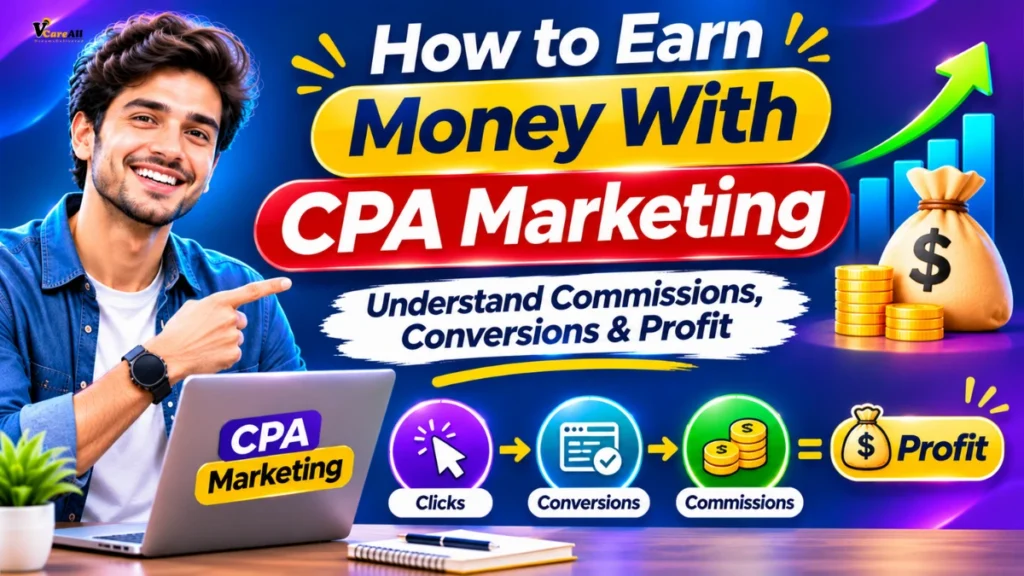
How Much Money Can You Make With CPA Affiliate Marketing?
This is probably one of the first questions that comes to mind when researching what is CPA affiliate marketing.
The answer depends on several factors.
Your earnings can vary based on your niche, traffic volume, audience quality, offer commission, conversion rate, approval rate, and expenses.
There is no reliable fixed amount that every beginner can expect to earn.
Some affiliates may generate little or no revenue, especially while learning. Others may build profitable campaigns with experience and consistent optimization.
Let’s look at an illustrative commission table.
| Approved Conversions | Commission Per Action | Total Commission |
|---|---|---|
| 10 | $2 | $20 |
| 25 | $4 | $100 |
| 50 | $5 | $250 |
| 100 | $8 | $800 |
| 200 | $10 | $2,000 |
These are hypothetical calculations, not income forecasts or representative industry results.
They also show gross commission revenue, not necessarily profit.
If you pay for advertising, content creation, hosting, email services, or tracking tools, those costs must be considered.
For example, earning $500 in commissions after spending $600 on advertisements means you’ve lost money.
On the other hand, a smaller campaign may be profitable if it produces approved conversions at a reasonable cost.
So instead of asking only how much money CPA marketing can generate, ask a more useful question:
Can I attract qualified visitors and generate approved conversions at a sustainable cost?
That’s the kind of thinking that can help you build a real marketing business.
Best CPA Affiliate Marketing Networks to Explore
Choosing a legitimate network is an important part of getting started.
Different networks specialize in different offers, industries, countries, and affiliate experience levels.
Some may offer direct signup options, while others require an application, a website, or a conversation with an affiliate manager.
Here are several established affiliate platforms worth researching.
| Affiliate Platform | General Focus | What to Check |
|---|---|---|
| MaxBounty | Performance marketing and CPA campaigns | Application process and traffic restrictions |
| Perform[cb] | Performance-based customer acquisition | Offer eligibility and approval requirements |
| Admitad | Affiliate partnerships across multiple industries | Available programs and regional eligibility |
| Awin | Advertiser and publisher affiliate partnerships | Advertiser terms and commission models |
| impact.com | Brand partnerships and affiliate management | Individual program acceptance criteria |
| CJ Affiliate | Affiliate programs from participating advertisers | Publisher requirements and offer conditions |
Not every program on these platforms uses a CPA payout model, and availability can change.
Before applying, visit the official platform website and check its current policies.
Also investigate the minimum payout threshold, payment methods, payment schedule, supported countries, and tracking procedures.
A trustworthy platform should provide clear information about how and when commissions become payable.
Be cautious of unfamiliar websites making unrealistic income promises or demanding suspicious upfront payments for access to offers.
Common CPA Affiliate Marketing Mistakes to Avoid
Even an interesting offer can perform poorly if your strategy isn’t suitable.
Here are some common mistakes beginners should watch for.
Promoting Too Many Offers at Once
Trying several unrelated campaigns can make it difficult to understand what’s working.
Start with a focused set of offers relevant to one audience.
Ignoring Campaign Restrictions
Every offer has rules about how affiliates may generate traffic and which actions qualify.
Ignoring those rules can lead to rejected commissions or account restrictions.
Choosing Offers Only for High Payouts
A large commission doesn’t mean the offer will convert well.
Consider relevance, eligibility requirements, advertiser quality, and actual profitability.
Creating Content Only for Search Engines
Repeating keywords unnaturally or publishing shallow affiliate pages can make your website less helpful.
Focus on genuine information and useful comparisons.
Expecting Immediate Results
Organic content may take time to attract visitors, while paid campaigns may require testing before becoming profitable.
Don’t treat affiliate marketing as guaranteed passive income.
Failing to Track Expenses
Commission revenue is not the same as profit.
Keep records of marketing costs, tools, approved commissions, and other business expenses.
Not Disclosing Affiliate Relationships
Readers should know when you may receive compensation through a recommendation.
Use clear disclosures close to relevant affiliate promotions, following applicable laws and platform rules.
Is CPA Affiliate Marketing Safe and Legitimate?
Yes, CPA affiliate marketing is a legitimate performance-based business model when conducted through genuine programs and compliant marketing practices.
Businesses use affiliate partnerships to acquire leads, customers, registrations, and other valuable results.
However, the existence of legitimate CPA programs doesn’t mean every network or offer is trustworthy.
You should always research a program before sharing its offers with your audience.
Look for a transparent company website, clearly explained terms, reasonable data collection practices, and a reliable payment process.
Avoid campaigns that require misleading claims, unauthorized use of personal information, or suspicious registration methods.
Pay special attention to offers involving sensitive personal or financial information.
You should also follow advertising disclosure requirements and privacy laws that apply to your location and target audience.
For example, when promoting offers to US consumers, relevant FTC endorsement and disclosure guidance may apply.
If your website uses affiliate links, clearly explain your financial relationship where required.
Remember, building an audience’s trust is much more valuable than collecting a few questionable commissions.
Do You Need a Website for CPA Affiliate Marketing?
Not necessarily.
Some CPA programs allow affiliates to promote offers through social media, videos, newsletters, or other approved channels.
However, having your own website can offer several advantages.
A website gives you a place to publish educational content, organize articles, build a recognizable brand, and attract search traffic.
It also allows visitors to learn more about a product or service before deciding whether to follow your recommendation.
For example, imagine building a blog that explains online business tools.
You could publish beginner guides, comparison articles, tutorials, and practical tips.
Relevant affiliate offers could then support that content where appropriate.
Over time, your website could become a useful resource for people searching for information in your niche.
That said, a website alone doesn’t guarantee traffic or commissions.
Content quality, competition, technical performance, and audience trust all matter.
If you don’t have a website yet, investigate whether your chosen program permits your preferred alternative traffic source.
Is CPA Affiliate Marketing Worth Trying for Beginners?
CPA affiliate marketing can be worth exploring if you’re interested in digital marketing, content creation, and learning how online advertising works.
It offers a way to understand performance-based campaigns without necessarily managing physical products, shipping, or customer orders yourself.
However, that doesn’t make it effortless.
You still need to research offers, attract suitable audiences, and follow campaign conditions.
A beginner who enjoys writing might start with educational blog posts.
Someone comfortable creating videos might explore tutorials and software comparisons.
A person with paid advertising experience might test carefully selected campaigns within an affordable budget.
The best approach depends on your skills, available time, resources, and willingness to learn.
Rather than expecting a certain income in your first month, consider setting learning goals.
Focus on understanding one niche, comparing legitimate offers, creating useful content, and measuring results.
Those early lessons can be valuable even before your campaigns become profitable.
Find the Right CPA Offers for You!
Learn what to check before choosing an affiliate network or campaign.
Focus on reliable programs, relevant offers, and clear payment terms.
Final Thoughts: Start Small, Learn Smart, and Build With Confidence
So, what is CPA affiliate marketing, and is it worth exploring?
At its core, it’s a performance-based model that rewards affiliates for generating specific actions that businesses value.
Those actions might include registrations, qualified leads, app installations, trials, or purchases.
What makes CPA marketing interesting is the flexibility it offers.
You can explore different niches, build useful content, test approved traffic sources, and improve your campaigns using performance data.
But remember, earning commissions isn’t simply about sharing links. It’s about connecting the right people with relevant offers.
If you’re just beginning, don’t feel pressured to launch several campaigns immediately.
Start with one niche you understand. Research legitimate programs, select useful offers, publish helpful content, and learn how to measure genuine results.
Avoid shortcuts, unrealistic income promises, and strategies that compromise your audience’s trust.
With patience, consistent learning, and responsible promotion, you can develop practical affiliate marketing skills and evaluate whether CPA marketing is a suitable opportunity for you.
Your first goal shouldn’t be to earn the biggest commission. It should be to understand your audience, deliver real value, and build a strategy you can improve over time.
Frequently Asked Questions About CPA Affiliate Marketing
What is CPA affiliate marketing in simple words?
CPA affiliate marketing is a method of earning commissions by promoting an advertiser’s offer and generating specific qualifying actions. These actions may include registrations, free-trial signups, lead submissions, app installations, or purchases. You earn a commission when the action meets the advertiser’s requirements.
Can beginners start CPA affiliate marketing without experience?
Yes, beginners can learn CPA marketing without previous experience. However, some affiliate networks have application requirements or prefer publishers with established websites or traffic sources. Start by understanding the basics, researching trustworthy programs, and creating useful content for a specific audience.
Is CPA affiliate marketing free to start?
Some affiliate programs are free to join, and certain approved organic traffic methods may not require advertising expenditure. However, running a website, using marketing software, producing content, or testing paid ads can involve costs. Always review any fees and conditions before joining a platform.
Do I need a website to earn money with CPA marketing?
Not always. Some advertisers accept traffic from approved social media platforms, video content, or email newsletters. Others require a website or specific promotional channels. Check each program’s policies to confirm which methods are permitted.
How do CPA affiliates get paid?
CPA affiliates typically receive commissions for approved conversions. Payments may be processed by an affiliate network or directly by an advertiser. Available payment methods, minimum payout thresholds, verification periods, and payment schedules vary by program.
What is the difference between CPA and CPC marketing?
CPA means Cost Per Action or Cost Per Acquisition, while CPC means Cost Per Click. In a CPA-based affiliate program, payment is linked to an approved action. In a CPC-based advertising arrangement, payment is linked to qualifying clicks. The models reward different outcomes.
Which niches are suitable for CPA affiliate marketing beginners?
Software, online education, productivity tools, mobile applications, and business services are potential areas to explore. A suitable niche should match your knowledge, audience interests, available offers, and permitted traffic methods. No niche guarantees earnings.
How long does it take to make money with CPA affiliate marketing?
There is no fixed timeline. Results depend on your traffic source, audience, offer, conversion requirements, and marketing strategy. Organic content can take time to attract visitors, while paid campaigns can generate data sooner but involve financial risk. Some beginners may not earn commissions at all.
Can I use paid ads for CPA affiliate marketing?
Yes, if the advertiser and affiliate network allow your chosen paid advertising method. You must also comply with the advertising platform’s policies. Start with controlled testing, monitor costs, and never assume a campaign will be profitable simply because it generates clicks.
Is CPA affiliate marketing better than traditional affiliate marketing?
Neither approach is universally better. CPA marketing may reward leads or registrations without requiring a sale, while other affiliate programs may offer larger or recurring commissions for purchases. The better option depends on your audience, offer quality, commission structure, conversion performance, and expenses.
