Getting traffic sounds easy when you are planning a website.
You publish a few pages, add some useful content, share links on social media, and expect visitors to start coming in.
But in reality, it often does not happen that quickly.
You may spend weeks creating content and still see only a small number of visitors in your analytics dashboard.
That is usually when website owners start thinking about paid traffic.
And the first question that comes to mind is:
Should I buy traffic and clicks to grow my website faster?
The answer is not simply yes or no.
Paid traffic can be useful, but only when you understand what kind of traffic you are buying, where it comes from, and what you expect visitors to do after landing on your website.
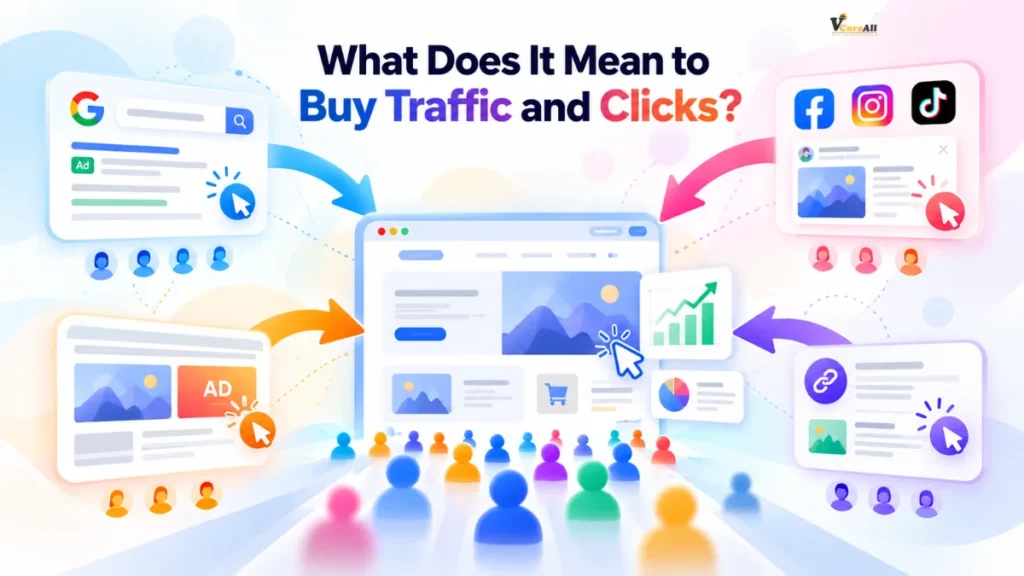
Because 10,000 random clicks may look impressive on paper, but they can be almost useless if those visitors have no interest in your content.
On the other hand, 500 highly relevant visitors can sometimes be far more valuable.
That is why quality matters more than volume.
If you are planning to buy traffic and clicks, the smartest approach is to focus on targeting, engagement, tracking, and real user behavior.
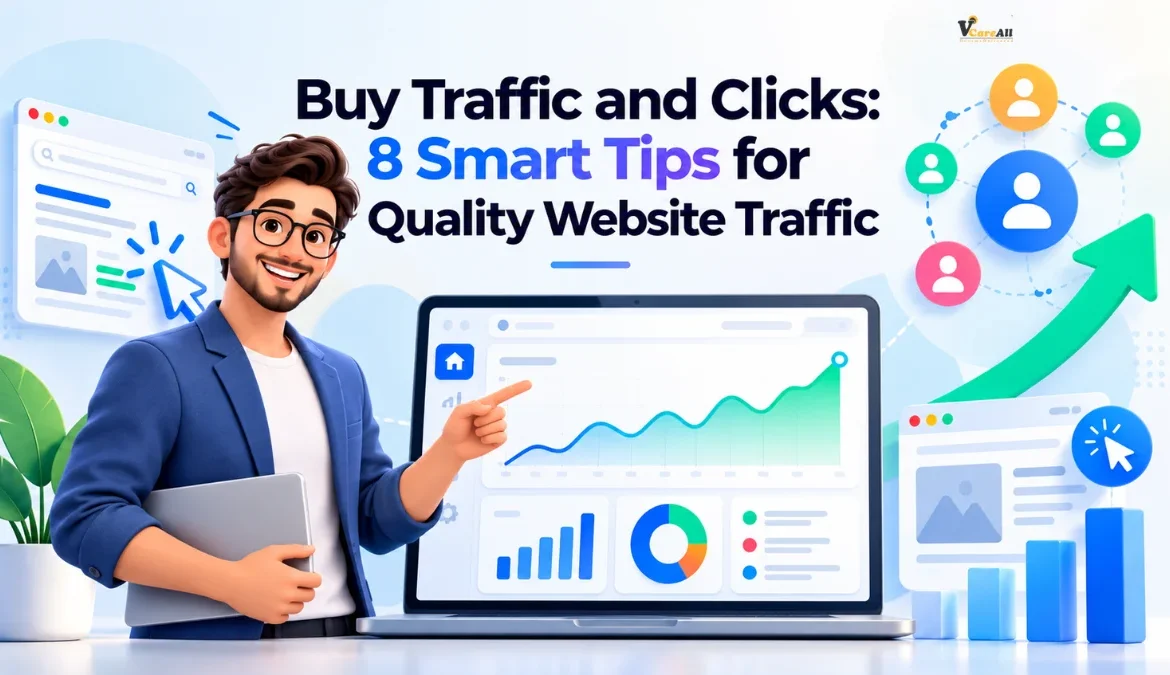
Here are 8 smart tips that can help you attract better-quality website traffic and avoid wasting your budget.
Ready to Attract Better Website Traffic?
Reach more relevant visitors with a smarter traffic strategy.
Know Why You Want More Traffic
Before you spend money on traffic, ask yourself one simple question:
What exactly do I want visitors to do?
A lot of people say, “I want more website traffic.”
But traffic itself is not really a final goal.
You may want visitors to:
- read your blog
- visit a product page
- sign up for your newsletter
- fill out a form
- request a quote
- download a guide
- buy a product
- create an account
- book a call
These are all different goals, and each one requires a different traffic strategy.
For example, if you run a blog, you may care more about engaged readers and returning visitors.
If you run an ecommerce store, you may care about product views, cart activity, and sales.
If you run a service business, form submissions and qualified leads may matter more.
So before you buy website traffic, define your goal first.
A simple formula can help:
Traffic Source → Audience → Landing Page → Action → Result
For example:
Paid search → Small business owners → CRM comparison page → Free trial → Signups
That is much more useful than simply saying, “I need 5,000 visitors.”
Choose Targeted Traffic Instead of Random Clicks
Not all visitors are equally useful.
This is probably the biggest mistake people make when they try to buy traffic and clicks.
They focus on numbers.
They see packages offering thousands of visitors and think more traffic automatically means more results.
It does not.
Relevant traffic is usually far more valuable than random traffic.
Imagine you run a website that sells productivity software for small business owners.
Which option sounds better?
- 10,000 random visitors from different interests
- 1,000 visitors interested in business tools, productivity, and software
The second group is much smaller, but it is likely to be more useful.
What is targeted website traffic?
Targeted traffic is made up of visitors who match certain characteristics.
These may include:
- location
- age
- language
- device
- interests
- keywords
- search behavior
- industry
- job role
- previous website activity
The more closely your visitors match your ideal audience, the better your chances of meaningful engagement.
General traffic vs targeted traffic
| General Traffic | Targeted Traffic |
|---|---|
| Broad audience | Specific audience |
| Lower relevance | Higher relevance |
| Focused on volume | Focused on intent |
| Harder to optimize | Easier to analyze |
| May leave quickly | More likely to explore |
This does not mean targeted traffic guarantees leads or sales.
Nothing does.
But it gives you a much stronger starting point.
Turn Clicks Into Meaningful Visits
Focus on quality traffic that matches your audience and goals.
Check Where the Traffic Is Actually Coming From
Before you pay for any traffic source, find out where the visitors are coming from.
This sounds obvious, but it is something many beginners skip.
Not all paid traffic works in the same way.
Traffic can come from:
- paid search ads
- social media ads
- native advertising
- display advertising
- sponsored content
- publisher websites
- referral networks
- email promotions
- content discovery platforms
Each source has a different level of user intent.
For example, someone searching for a specific product on Google may already be interested in buying.
Someone seeing a display ad while reading an unrelated article may only be casually browsing.
Both are traffic, but they are not the same quality.
Questions to ask before buying traffic
Before you buy traffic and clicks, try to understand:
- Where will my visitors come from?
- Can I choose the country or region?
- Can I target specific devices?
- Can I choose interests or keywords?
- Is the traffic from real users?
- How is the click generated?
- Can I track campaigns separately?
- Can I pause or adjust the campaign?
If the traffic source cannot clearly explain how visitors are generated, that is a warning sign.
Be careful with unrealistic promises
You should also be cautious when you see promises such as:
- guaranteed sales
- guaranteed first-page rankings
- guaranteed leads
- instant SEO results
- huge traffic for extremely low prices
Traffic can bring visitors.
It cannot guarantee what those visitors will do.
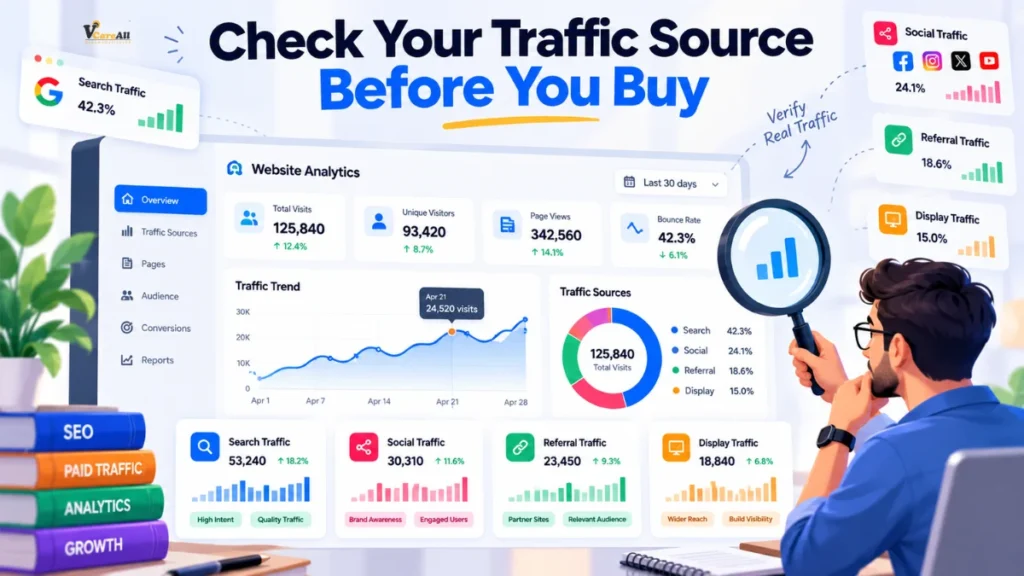
Fix Your Landing Page Before Sending Paid Visitors
There is no point buying traffic if your landing page is weak.
You can bring thousands of people to your website, but if the page is confusing, slow, or badly designed, they may leave immediately.
Before launching a campaign, check the page like a visitor would.
Ask yourself:
Is the headline clear?
Visitors should understand what the page is about within a few seconds.
Does the page match the ad or source?
If someone clicks an ad about email marketing tips and lands on a homepage selling web hosting, that creates confusion.
Is the page mobile-friendly?
A large amount of web traffic comes from mobile devices.
If your page is difficult to use on a phone, you may lose visitors.
Is there a clear next step?
Visitors should know what to do next.
That might be:
- read more
- compare plans
- sign up
- request details
- download something
- contact you
- view products
Does the page load quickly?
Slow-loading pages can waste paid traffic.
If someone clicks your link and waits too long, they may simply leave.
When you buy website traffic, your landing page becomes part of the campaign.
Traffic quality matters, but page quality matters too.
Start With a Small Test Instead of Going Big
One of the smartest things you can do is start small.
Do not spend your entire traffic budget on one campaign before you know whether it works.
Use the first campaign as a test.
You can test:
- audience
- location
- headline
- landing page
- traffic source
- device
- call to action
- keyword group
Example
Suppose you run two campaigns.
Campaign A
- 1,000 visitors
- 500 engaged sessions
- 60 leads
Campaign B
- 3,000 visitors
- 350 engaged sessions
- 18 leads
Campaign B brought more traffic.
But Campaign A brought more engaged visitors and more leads.
That tells you something important.
More traffic does not always mean better traffic.
Why small tests work better
Testing helps you answer questions such as:
- Which audience is more interested?
- Which page keeps people engaged?
- Which source delivers better visitors?
- Which locations perform best?
- Which devices convert better?
Once you have enough data, you can decide whether to increase spending.
Want More Targeted Website Visitors?
Discover traffic options designed around relevance and user intent.
Track What Visitors Do After They Click
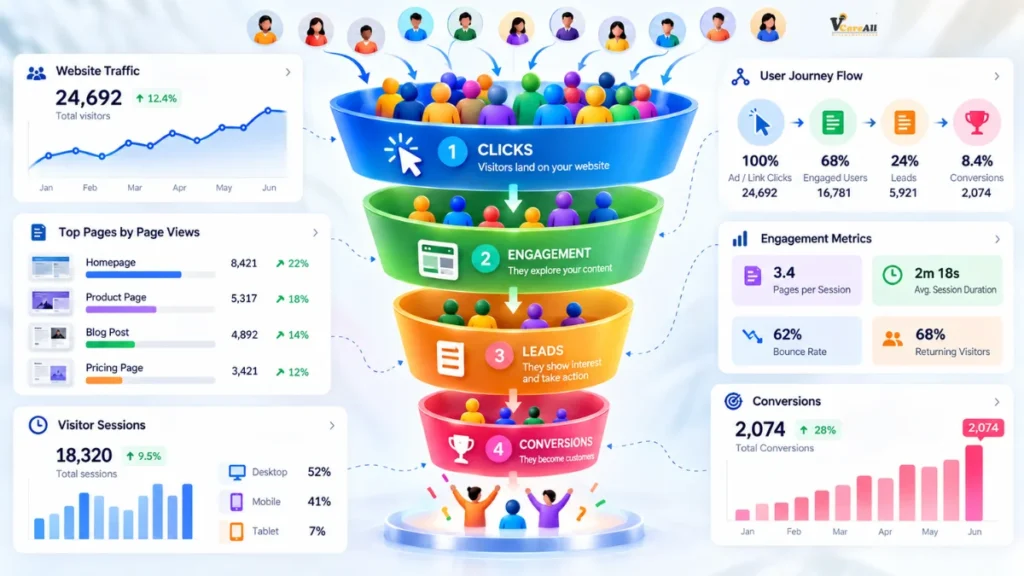
Clicks are only the first step.
If you are spending money to buy traffic and clicks, you need to know what happens after visitors arrive.
Many people make the mistake of checking only one metric:
Visitors
That is not enough.
You should also look at behavior.
Important traffic metrics
Engagement
Are people interacting with the page or leaving instantly?
Pages viewed
Do visitors explore other parts of your website?
Engagement time
How long are people actually spending on the site?
Leads
Are visitors filling out forms, signing up, or contacting you?
Sales
Are visitors making purchases?
Returning visitors
Do people come back later?
Cost per lead
How much are you spending to generate one potential customer?
Cost per acquisition
How much does it cost to acquire one customer or conversion?
Simple measurement table
| Metric | What It Shows |
|---|---|
| Visitors | Total traffic |
| Sessions | Number of visits |
| Engagement | Visitor activity |
| Pages viewed | Depth of interest |
| Leads | Potential customers |
| Sales | Revenue-related results |
| Cost per lead | Lead efficiency |
| Cost per acquisition | Customer acquisition cost |
The point is simple:
Do not judge paid traffic only by click numbers.
Judge it by what those clicks actually produce.
Learn to Spot Low-Quality Traffic
Cheap traffic can be tempting.
Especially when you see offers promising thousands of visitors for very little money.
But this is where you need to be careful.
Low-quality traffic may increase your numbers without adding any real value.
Warning signs to watch
Possible red flags include:
- very sudden traffic spikes
- almost no engagement
- extremely short sessions
- visitors from unexpected countries
- repeated traffic patterns
- lots of clicks but zero actions
- suspicious referral domains
- unusual device patterns
One unusual metric does not automatically mean the traffic is bad.
But multiple strange patterns can be a reason to investigate.
Compare traffic sources
If you use multiple sources, compare them.
For example:
| Source | Visitors | Engagement | Leads |
|---|---|---|---|
| Source A | 5,000 | Low | 8 |
| Source B | 1,500 | High | 72 |
Source B may be smaller, but it is clearly bringing more useful visitors.
This is why analytics matter.
Without tracking, you may continue spending money on traffic that does not help your business.
Use Paid Traffic Alongside SEO, Not Instead of SEO
Paid traffic can help you get visitors quickly.
SEO can help you build visibility over time.
They are not the same thing, and they do not need to compete.
A smart strategy can use both.
Paid traffic can help with:
- product launches
- new websites
- testing landing pages
- reaching specific audiences
- promoting new content
- generating early data
- increasing awareness
SEO can help with:
- long-term search visibility
- evergreen traffic
- educational content
- organic discovery
- building topical authority
- attracting visitors over time
Paid traffic usually stops when the campaign stops.
Organic traffic may continue if your pages remain useful and visible in search.
That is why many businesses use both methods together.
You can use paid traffic for speed and SEO for long-term growth.
Make Every Website Click Count
Choose better targeting instead of chasing traffic numbers alone.
What Makes Website Traffic High Quality?
Quality website traffic usually has a few things in common.
Relevance
Visitors are genuinely interested in the topic.
Intent
They have a reason to visit.
Engagement
They read, click, browse, or interact.
Transparency
You know where the traffic came from.
Measurability
You can track performance.
Business Value
The traffic supports your actual goal.
That goal could be:
- readers
- leads
- sales
- signups
- downloads
- product views
- brand awareness
Different websites have different definitions of quality.
That is why it is important to set goals before buying traffic.
Paid Traffic vs Organic Traffic
Both have advantages.
| Factor | Paid Traffic | Organic Traffic |
|---|---|---|
| Speed | Faster | Usually slower |
| Cost | Ongoing spend | SEO/content investment |
| Targeting | Strong | Search-based |
| Testing | Faster | Slower |
| Duration | Stops when spend stops | Can continue |
| Control | More direct | Less direct |
| Long-term value | Depends on campaign | Can compound over time |
A balanced strategy is often better than depending on only one source.
How Much Traffic Should You Buy?
There is no perfect number.
The right amount depends on:
- your budget
- niche
- traffic cost
- campaign goal
- landing page
- conversion rate
- audience size
If you are new to paid traffic, smaller tests are usually more useful than large campaigns.
For example, instead of buying 50,000 visitors immediately, you may test a smaller audience first.
Then look at:
- engagement
- leads
- sales
- cost
- conversion rate
If the traffic performs well, you can increase your budget gradually.
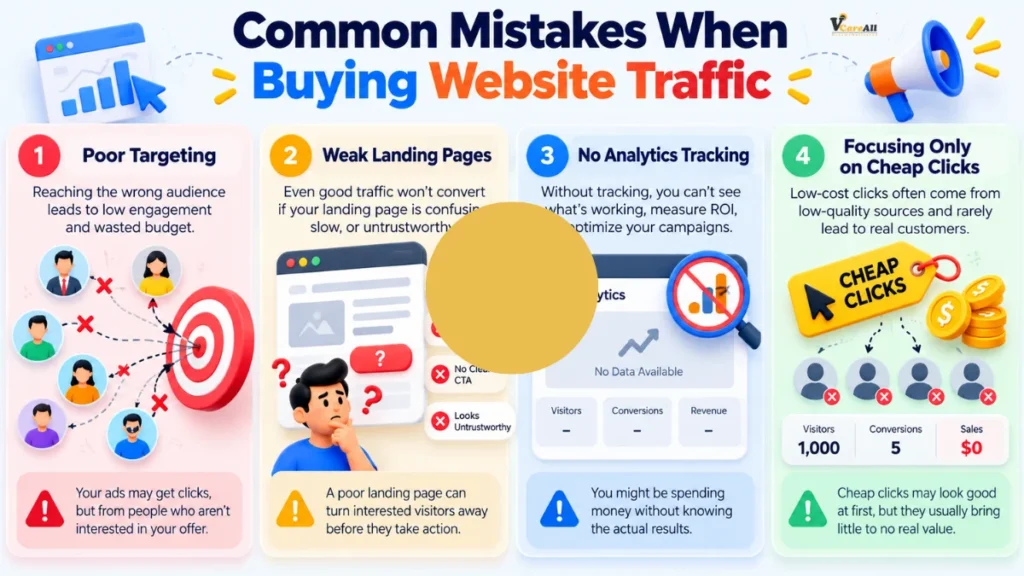
Common Mistakes to Avoid
If you are planning to buy traffic and clicks, avoid these common mistakes.
Buying traffic only because it is cheap
Cheap traffic is not always useful traffic.
Ignoring targeting
Random visitors may not care about your website.
Sending all traffic to the homepage
A focused landing page often works better.
Not tracking results
If you cannot measure performance, you cannot improve it.
Looking only at visitor numbers
More visitors do not always mean better results.
Scaling too quickly
Test before increasing your spend.
Expecting guaranteed results
Traffic does not guarantee leads, sales, or rankings.
Quick Checklist Before Buying Traffic
Use this simple checklist before starting a campaign.
Audience
- Who do I want to reach?
- Where are they located?
- What are they interested in?
Traffic Source
- Where does the traffic come from?
- Can I target users?
- Can I measure results?
Landing Page
- Is the page fast?
- Is it mobile-friendly?
- Is the headline clear?
- Is there a clear action?
Tracking
- Is analytics installed?
- Are conversions being tracked?
- Can I identify each campaign?
Budget
- What is my test budget?
- What result would make the campaign worthwhile?
If you cannot answer these questions, fix those areas before spending more.
Build a Smarter Traffic Strategy
Test, measure, and improve your campaigns with real visitor data.
Final Thoughts
If you want to buy traffic and clicks, focus less on the number of visitors and more on the quality of those visitors.
A smaller group of interested users can be far more valuable than a huge amount of random traffic.
The best results usually come from a simple process:
Choose the right audience.
Use a reliable traffic source.
Send visitors to a strong landing page.
Track what they do.
Improve based on real data.
Paid traffic can be a useful part of your marketing strategy, but it should not be treated as a shortcut.
Use it as a tool for testing, learning, and reaching the right people.
And remember one thing:
The goal is not to get more clicks. The goal is to get better clicks.
Frequently Asked Questions
1. What does it mean to buy traffic and clicks?
To buy traffic and clicks means paying for visitors to reach your website, landing page, blog, product page, or another online destination. The traffic may come from search ads, social ads, display campaigns, sponsored placements, native ads, or other paid sources. The goal should not simply be increasing visitor numbers. It is more useful to focus on relevant visitors who may read, explore, sign up, contact you, or complete another meaningful action.
2. Is it safe to buy website traffic?
Buying website traffic can be a normal marketing activity when you use transparent and reputable advertising sources. The important thing is to understand where the traffic comes from and how it is generated. Avoid services that make unrealistic promises about guaranteed rankings, leads, or sales. Start with a smaller test, monitor visitor behavior, and check metrics such as engagement, location, leads, and conversions before increasing your budget.
3. Can buying traffic improve Google rankings?
Buying traffic does not automatically improve your Google rankings. Paid traffic and organic search rankings are different things. Be cautious if someone promises higher rankings simply by sending clicks to your website. Paid traffic can still help more people discover your content, but SEO growth usually depends on factors such as useful content, search intent, technical quality, internal linking, authority, and overall website experience.
4. How do I know if website traffic is high quality?
Quality traffic usually comes from visitors who are relevant to your website and interact meaningfully with your content. Look at engagement, pages viewed, key actions, leads, sales, returning visitors, and geographic relevance. The exact definition depends on your website. A blog may focus on reading time, while an ecommerce store may care more about product views, cart actions, and purchases.
5. What should I check before buying traffic?
Before you buy traffic and clicks, check the traffic source, targeting options, geographic controls, device targeting, campaign tracking, and reporting. You should also review your landing page. Make sure it loads quickly, works on mobile, matches the campaign message, and gives visitors a clear next step. It is also important to have analytics and conversion tracking in place before the campaign starts.
6. What is the difference between targeted traffic and general traffic?
General traffic includes a broad mix of visitors who may or may not be interested in your website. Targeted traffic focuses on people based on location, interests, keywords, industry, behavior, or other characteristics. Targeting does not guarantee conversions, but it can help bring visitors who are more likely to care about your content or offer.
7. How much website traffic should a beginner buy?
There is no fixed amount. Beginners should usually start with a smaller test budget instead of buying a very large traffic package immediately. Use the first campaign to understand visitor behavior, engagement, lead generation, and cost. Once you know which audience and traffic source performs better, you can gradually increase your spending.
8. How can I measure whether paid traffic is working?
Start with your campaign goal. If you want awareness, look at engaged sessions and page views. If you want leads, track form submissions and cost per lead. If you run an online store, monitor product views, cart activity, purchases, and acquisition cost. The best way to judge traffic is by the actions visitors take after clicking, not just by total visitor numbers.
9. Can bought traffic generate leads or sales?
Yes, paid traffic can generate leads or sales when the audience, offer, landing page, and targeting are aligned. However, traffic alone cannot guarantee results. Visitors still need a reason to trust your website and take action. That is why your page content, offer, pricing, design, and user experience matter just as much as the traffic source.
10. What mistakes should I avoid when buying traffic?
Common mistakes include choosing traffic only because it is cheap, ignoring targeting, failing to track results, sending all visitors to the homepage, and judging success only by traffic volume. Another common mistake is increasing the budget too quickly. Start small, test different sources, monitor performance, and scale only when the data shows that the traffic is useful.