
Have you ever wondered why some affiliate marketers earn hundreds of dollars from a few clicks while others struggle to make even a single sale despite receiving thousands of visitors?
The secret isn’t always about getting more traffic. Sometimes, it’s about understanding how much money each click is actually worth.
Imagine two affiliate marketers promoting different products. One generates 5,000 clicks and earns $200, while another receives only 1,000 clicks but earns $500. Who is performing better?
Surprisingly, the second marketer is earning much more from every click. This is where EPC in affiliate marketing becomes important.
But what is EPC in affiliate marketing, and why should beginners, bloggers, content creators, and experienced marketers pay attention to it?
EPC stands for Earnings Per Click, a performance metric that helps affiliate marketers understand the average commission they generate whenever someone clicks an affiliate link.
Understanding EPC can help you select better affiliate programs, improve your marketing strategy, identify profitable campaigns, and avoid wasting money on poorly performing offers.
Whether you’re promoting products through a blog, YouTube channel, email newsletter, social media, or paid advertisements, EPC gives you valuable information about how effectively your traffic generates revenue.
In this complete guide, you’ll discover the EPC meaning, calculation formula, real-world examples, important differences between marketing metrics, strategies to improve EPC, and common mistakes to avoid.
More importantly, you’ll learn how to use EPC to make smarter affiliate marketing decisions in 2026 and beyond.
Turn Every Click Into an Opportunity!
Discover how EPC helps you understand affiliate earnings and make smarter marketing decisions.

What Is EPC in Affiliate Marketing?
EPC in affiliate marketing means Earnings Per Click. It measures how much commission an affiliate marketer earns on average for each tracked click on their affiliate links.
In simple words, EPC tells you the average financial value of a click.
For example, suppose you promote a software product through your website. During one month:
- Your affiliate link receives 1,000 clicks.
- Twenty visitors purchase the software.
- You earn $400 in total affiliate commissions.
- Your EPC becomes $0.40.
This means every tracked click generated an average of $0.40 in commission, even though most visitors did not make a purchase.
EPC does not mean you automatically receive money whenever someone clicks your affiliate link. In a typical commission-per-sale program, earnings occur only after a qualifying purchase or another eligible action.
The metric distributes your total commission across all tracked clicks to show average performance.
Understanding EPC With a Simple Example
Consider the following affiliate campaigns:
| Affiliate Campaign | Clicks | Commission Earned | EPC |
|---|---|---|---|
| Campaign A | 500 | $100 | $0.20 |
| Campaign B | 1,000 | $350 | $0.35 |
| Campaign C | 2,000 | $400 | $0.20 |
| Campaign D | 800 | $480 | $0.60 |
Campaign D generates the highest earnings per click, even though Campaign C receives more traffic.
This comparison explains why EPC is useful. It helps marketers look beyond traffic numbers and focus on how efficiently their affiliate links generate commissions.
However, EPC alone cannot tell you which campaign produces the highest profit. Advertising costs, refunds, tracking accuracy, and customer behavior also matter.
Why EPC Matters for Affiliate Marketers
Affiliate marketing is not simply about attracting visitors. It’s about connecting interested people with products that solve their problems.
EPC helps you:
- Identify affiliate products with stronger earning potential.
- Compare campaigns using a common performance metric.
- Understand whether your traffic converts into revenue.
- Find opportunities to improve content and product recommendations.
- Evaluate different traffic sources and marketing channels.
- Make more informed decisions before increasing advertising budgets.
- Monitor the impact of changes to your promotions.
For beginners, EPC is especially valuable because it replaces guesswork with measurable information.
Instead of asking, “How many people clicked my affiliate link?” you can ask, “How much commission did those clicks generate?”
That small change in thinking can make a significant difference in how you manage affiliate campaigns.
How to Calculate EPC in Affiliate Marketing
Calculating EPC is surprisingly simple. You only need two important numbers: your total affiliate earnings and the total number of tracked affiliate clicks over the same reporting period.
EPC Formula
EPC = Total Affiliate Earnings ÷ Total Affiliate Clicks
For example:
- Total affiliate earnings: $250
- Total affiliate clicks: 500
EPC = $250 ÷ 500 = $0.50
Your earnings per click are $0.50.
The higher the EPC, the more commission you generate on average from each tracked click, assuming the same reporting rules.
Step-by-Step EPC Calculation
Find Your Total Affiliate Earnings
Open your affiliate dashboard and check the commission generated during a specific period, such as the last 30 days.
For accurate comparisons, distinguish between pending, approved, and reversed commissions.
Check Your Total Tracked Clicks
Find the number of clicks recorded by your affiliate program during the same reporting period.
Remember that website visits, page views, and affiliate link clicks are different measurements.
Divide Earnings by Clicks
Apply the EPC formula to calculate your average earnings for each tracked click.
Compare the Result Over Time
Analyze whether your EPC is improving, declining, or remaining stable.
Consistent comparisons are usually more useful than judging performance from a single day.
Understanding 100-Click EPC
Some affiliate networks display EPC as earnings per 100 clicks instead of earnings per individual click.
The formula becomes:
100-Click EPC = (Total Earnings ÷ Total Clicks) × 100
Suppose an affiliate campaign earns $60 from 300 clicks.
- Standard EPC: $0.20
- 100-click EPC: $20
Both figures describe the same performance using different reporting scales.
Some dashboards may also use a 1,000-click calculation. Always check the platform’s definition before comparing EPC figures.
EPC Calculation Examples
| Earnings | Affiliate Clicks | Standard EPC | EPC per 100 Clicks |
|---|---|---|---|
| $50 | 250 | $0.20 | $20 |
| $120 | 400 | $0.30 | $30 |
| $300 | 600 | $0.50 | $50 |
| $500 | 1,000 | $0.50 | $50 |
| $900 | 1,500 | $0.60 | $60 |
These examples demonstrate an important lesson: generating more clicks does not automatically increase earnings per click.
The quality of those clicks and their ability to produce conversions matter.
Are Your Affiliate Clicks Making Money?
Understand the real value of your traffic and discover how to measure affiliate campaign performance.
What Is a Good EPC in Affiliate Marketing?
One of the most common questions beginners ask is, “What is a good EPC in affiliate marketing?”
There is no universal EPC value that guarantees success.
A good EPC depends on the products you promote, your affiliate commission structure, the audience you attract, your traffic source, and your marketing expenses.
For example, a $0.30 EPC might be excellent for someone receiving free organic traffic but unsustainable for someone paying $0.50 for every visitor.

Factors That Determine a Good EPC
Affiliate Niche
Different industries have different product prices, commission structures, and customer buying behaviors.
Software subscriptions, online education, consumer electronics, and lifestyle products may produce very different EPC figures.
Commission Structure
Some affiliate programs offer a fixed commission for every qualified sale, while others pay a percentage of the purchase amount.
Recurring subscription programs may also generate repeat commissions, depending on the agreement.
Traffic Quality
Visitors searching for a particular product review may be closer to purchasing than visitors casually browsing entertainment content.
Higher purchase intent can improve conversion rates and EPC.
Product Price
Expensive products may generate larger commissions per sale, but their conversion rates can differ from lower-priced products.
Conversion Rate
An affiliate offer that converts more clicks into qualifying sales can generate higher EPC, even when its individual commission is relatively small.
Illustrative EPC Comparison by Product Type
The following examples are hypothetical calculations, not verified industry averages or expected earnings.
| Product Type | Commission per Sale | Conversion Rate | Calculated EPC |
|---|---|---|---|
| Digital course | $30 | 2% | $0.60 |
| Software subscription | $50 | 3% | $1.50 |
| Physical product | $8 | 4% | $0.32 |
| Online service | $25 | 2% | $0.50 |
| Premium software | $100 | 1% | $1.00 |
The table shows that higher commissions do not always mean higher EPC.
A product with a smaller payout but a stronger conversion rate can outperform one offering a larger commission.
High EPC vs. Low EPC
A high EPC generally indicates that clicks are generating relatively strong affiliate earnings.
However, high EPC does not always mean higher profit.
For example, suppose two campaigns generate the following results:
| Metric | Campaign A | Campaign B |
|---|---|---|
| EPC | $1.20 | $0.70 |
| Average cost per click | $1.00 | $0.20 |
| Earnings after click costs | $0.20 | $0.50 |
Campaign B generates less revenue per click, but it leaves more money after click acquisition costs.
This is why experienced marketers evaluate EPC alongside conversion rate, cost per click, and overall return on investment.
The goal is not simply to achieve the highest EPC. The goal is to generate sustainable, profitable affiliate earnings.
EPC vs. CPC, CPA, RPM, and Conversion Rate: Key Differences
Affiliate marketing involves several performance metrics, and beginners often confuse their meanings.
Understanding the difference between EPC and other metrics is essential for evaluating your campaigns accurately.
EPC vs. CPC
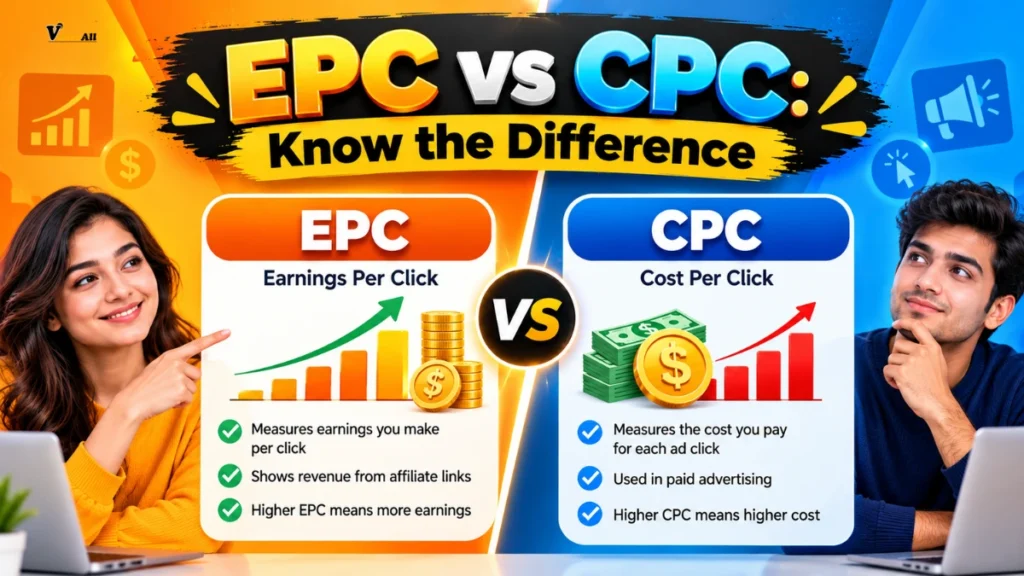
EPC stands for Earnings Per Click, while CPC stands for Cost Per Click.
- EPC: Measures average affiliate earnings generated per tracked click.
- CPC: Measures how much an advertiser pays for each ad click.
For example, if you spend $0.25 to acquire a visitor and generate $0.65 in affiliate commission per click, the difference is $0.40 before other expenses.
However, clicks counted by advertising platforms and affiliate networks may differ because of tracking, filtering, or attribution rules.
EPC vs. CPA
CPA commonly means Cost Per Acquisition or Cost Per Action.
While EPC evaluates average earnings per click, CPA measures how much you spend to generate a customer or qualifying action.
Affiliate networks may also use CPA to describe a commission model where affiliates are paid for specific actions.
EPC vs. RPM
RPM means Revenue Per Mille, or revenue per 1,000 impressions.
RPM is frequently used in advertising and website monetization.
EPC calculates earnings per affiliate link click, while RPM measures revenue relative to impressions or page views.
These metrics answer different questions about monetization performance.
EPC vs. Conversion Rate
Conversion rate measures the percentage of tracked clicks that result in a qualifying action.
For example, if 100 visitors click an affiliate link and five complete a purchase, the conversion rate is 5%.
EPC adds the financial value of those conversions.
If each of those five purchases produces a $20 commission:
- Total earnings: $100
- Total clicks: 100
- Conversion rate: 5%
- EPC: $1.00
Affiliate Marketing Metrics Comparison
| Metric | Full Form | Main Purpose |
|---|---|---|
| EPC | Earnings Per Click | Measures average affiliate earnings per click |
| CPC | Cost Per Click | Measures advertising cost per click |
| CPA | Cost Per Acquisition/Action | Measures acquisition or action costs |
| RPM | Revenue Per Mille | Measures revenue per 1,000 impressions |
| CR | Conversion Rate | Measures the percentage of clicks that convert |
| CTR | Click-Through Rate | Measures the percentage of impressions generating clicks |
| ROI | Return on Investment | Measures returns relative to investment costs |
Successful affiliate marketers analyze these measurements together rather than depending on a single number.
How to Increase EPC in Affiliate Marketing
Understanding the EPC formula is useful, but knowing how to improve EPC is even more valuable.
Here are practical strategies that can help affiliate marketers improve their earning potential.
Choose Affiliate Products That Match Your Audience
One of the biggest affiliate marketing mistakes is promoting products solely because they offer attractive commissions.
A product might pay $100 per sale, but if your audience has no interest in purchasing it, your EPC could remain extremely low.
Instead, prioritize relevance.
For example, if your website focuses on email marketing, your audience might be interested in:
- Email marketing software
- Email automation tools
- Email verification services
- Landing page builders
- Marketing analytics platforms
These products closely match the problems readers are trying to solve.
Practical Tip: Select products based on user needs, transparent pricing, product quality, and commission terms—not just advertised EPC.
Target High-Intent Keywords
Not every website visitor has the same purchasing intention.
Someone searching “what is affiliate marketing” may be looking for basic information.
Someone searching “best affiliate tracking software for beginners” may be actively comparing available options.
Both visitors are valuable, but their immediate goals are different.
Content targeting commercial research queries can help attract visitors who are closer to making purchasing decisions.
Examples include:
- Best affiliate marketing tools
- Affiliate software comparison
- Product A vs. Product B
- Product pricing and features
- Best tools for affiliate beginners
Use these keywords naturally in relevant articles rather than placing unrelated commercial terms inside informational content.
Create Helpful Product Reviews
A useful product review should help readers understand whether an offer genuinely meets their needs.
Include:
- Main features and benefits
- Pricing and available plans
- Advantages and disadvantages
- Suitable customer profiles
- Important limitations
- Alternatives and comparisons
- Actual testing results, when available
Avoid exaggerated claims such as “guaranteed earnings” or “the perfect solution for everyone.”
Transparent reviews can help users make informed decisions, which may improve the quality of traffic reaching affiliate offers.
Improve Your Call to Action
A call to action encourages readers to take the next step.
Compare these examples:
“Click here.”
“Compare available plans and features.”
The second CTA gives users a clearer understanding of what to expect.
Effective affiliate CTAs should be relevant, visible, and truthful.
Good examples include:
- Explore the product features.
- Compare available pricing plans.
- Read the full product details.
- Check whether this tool fits your needs.
- View the latest offer terms.
Avoid creating unnecessary urgency or promising benefits the advertiser does not guarantee.
Optimize Your Website for Mobile Users
A confusing website can discourage visitors from exploring recommendations.
Focus on:
- Fast-loading pages
- Responsive mobile layouts
- Readable fonts
- Simple navigation
- Clear buttons and links
- Limited intrusive pop-ups
- Helpful product comparisons
Visitors should understand your recommendation without struggling to navigate the page.
A better user experience can support meaningful engagement and encourage qualified referral clicks.
Test Different Affiliate Offers
Even similar products can perform differently with the same audience.
Test offers by comparing their approved commissions, tracking rules, conversion rates, and EPC.
For example, promote two relevant software products through separate, clearly labeled comparison sections.
Evaluate performance over a meaningful period.
Avoid declaring a winner after only a handful of clicks because small samples can produce misleading results.
Improve Traffic Quality Instead of Chasing Volume
An affiliate marketer receiving 10,000 uninterested visitors might earn less than someone attracting 1,000 highly relevant visitors.
Focus on traffic sources that connect your content with people genuinely interested in the topic.
Potential channels include:
- Organic Google Search
- Educational YouTube videos
- Relevant email newsletters
- Social media communities
- Helpful tutorials
- Targeted paid advertising
Measure each channel independently whenever possible.
The objective is not merely to increase visits but to attract people who genuinely benefit from your content.
Stop Guessing, Start Tracking!
Learn how to calculate Earnings Per Click and identify opportunities to improve your affiliate results.
How to Track and Analyze EPC in 2026
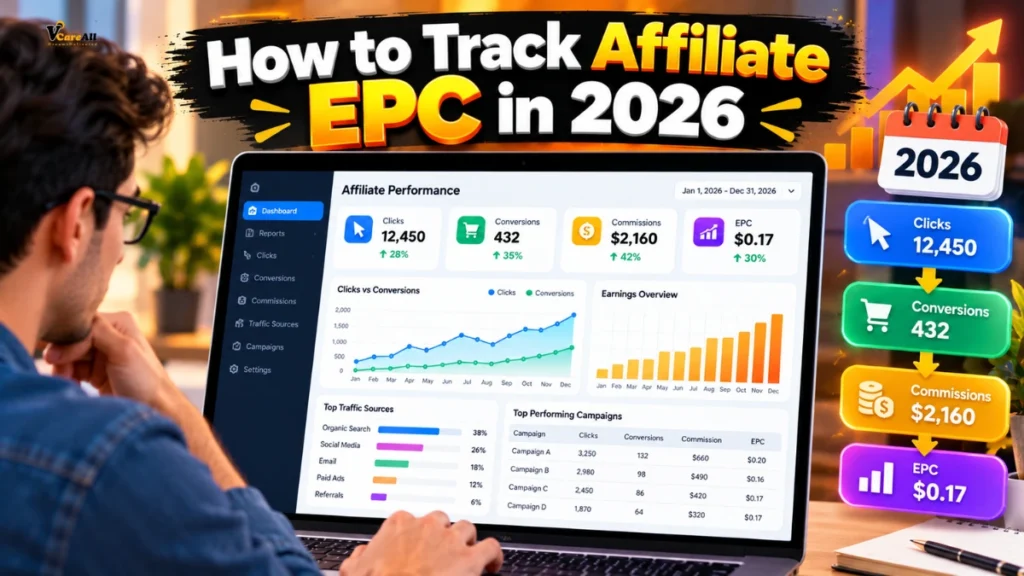
Tracking is essential because affiliate marketing decisions become more reliable when they are supported by actual performance data.
Modern affiliate programs commonly provide reporting dashboards that include clicks, conversions, commissions, and EPC.
Some platforms also allow performance comparisons across devices, campaigns, and referring sources.
Use Your Affiliate Network Dashboard
Start with your affiliate platform’s reporting tools.
Review the following measurements:
| Tracking Metric | What It Helps You Understand |
|---|---|
| Affiliate clicks | How many tracked visits you referred |
| Conversion rate | How frequently those visits produced actions |
| Pending commissions | Earnings awaiting validation |
| Approved commissions | Earnings validated by the network |
| Reversed commissions | Earnings removed due to cancellations or other reasons |
| EPC | Average earnings per tracked click |
| Traffic source | Where your referred visitors originated |
Different networks may include different commission types in their EPC calculation, so check the reporting documentation.
Use Website Analytics for Supporting Insights
Website analytics tools can help you understand how visitors interact with your content before clicking an affiliate link.
You can configure outbound click or custom affiliate-click events to analyze:
- Which blog posts generate referral clicks
- Which traffic channels drive engaged visitors
- How visitors interact with comparison pages
- Which CTA placements receive attention
- Which devices users prefer
Website analytics platforms do not automatically know your affiliate commissions. You’ll need data from your affiliate network or an appropriate integration to calculate earnings-based EPC.
Track Affiliate Links by Campaign
Using campaign identifiers, sub-IDs, or supported tracking parameters can help identify which content produces revenue.
For example, separate identifiers can distinguish clicks from a product review, newsletter, and video description.
Only use tracking methods permitted by the affiliate program, and avoid exposing personal information through tracking URLs.
Compare Performance Over Consistent Periods
Daily EPC can fluctuate significantly when conversion numbers are low.
Compare weekly and monthly performance using consistent definitions.
Also account for attribution delays. A customer may click today but purchase several days later.
Commissions can also change after refunds or program validation.
For this reason, recent EPC figures may not represent final approved earnings.
Current Trends Affecting Affiliate EPC
In 2026, affiliate marketers should pay particular attention to these practical developments:
AI-Assisted Content Discovery
Users can discover products through traditional search, AI-generated summaries, social platforms, and video content.
Clear, original comparisons and credible evidence help your content serve these different discovery journeys.
Privacy-Aware Tracking
Consent settings, browser restrictions, and cross-device journeys can affect attribution.
Understanding a program’s tracking arrangements helps explain why reported clicks and conversions sometimes differ.
First-Party Audience Relationships
Helpful newsletters and returning website visitors can support stronger audience relationships without depending entirely on search traffic.
Revenue-Quality Analysis
Examining validated commissions, refund rates, and profit alongside EPC provides a more complete picture than looking at clicks alone.
Transparent Affiliate Recommendations
Disclosing commercial relationships and publishing genuine product information helps readers evaluate your recommendations.
These are strategic considerations, not guarantees of higher EPC or better search rankings.
Common EPC Mistakes and How to Avoid Them
Even experienced affiliate marketers can misinterpret earnings per click.
Understanding common mistakes can protect your marketing budget and improve decision-making.
Comparing Different EPC Reporting Methods
A $40 EPC per 100 clicks is not the same as $40 earned per individual click.
Always check whether a platform reports EPC per click, per 100 clicks, or per 1,000 clicks.
Convert the figures to the same scale before comparing programs.
Ignoring Advertising Expenses
An affiliate campaign might generate impressive commissions while spending even more on advertising.
Track acquisition costs, management expenses, and other relevant costs before calling a campaign profitable.
Depending on Small Data Samples
One expensive sale from ten clicks can produce an unusually high EPC.
That does not guarantee similar results after 1,000 additional clicks.
Use larger, representative samples and evaluate performance across time.
Ignoring Refunds and Reversed Sales
Pending commissions are not always final earnings.
Refunded orders, invalid leads, and rejected transactions can reduce your final EPC.
Where available, use approved or validated commissions for long-term financial analysis.
Promoting Unrelated Affiliate Offers
A high-paying product may look attractive, but promoting irrelevant offers can hurt audience trust.
Recommend products that genuinely connect to the reader’s needs.
Overlooking Click Attribution
Ad platforms and affiliate networks may count clicks differently.
Differences can arise from duplicate click filtering, redirect failures, blocked tracking, attribution windows, and other reporting rules.
Investigate unexpected discrepancies rather than assuming every reported click should create an attributed sale.
Focusing Only on EPC
EPC is valuable, but it doesn’t measure everything.
A complete affiliate marketing performance review should consider:
- EPC and conversion rate
- Approved commissions
- Traffic acquisition costs
- Refund or reversal rates
- Total profit
- Campaign consistency
- Audience trust and product relevance
The most successful strategy is not necessarily the one with the highest individual metric. It is the one that produces reliable results while serving the audience effectively.
Unlock the Power of Affiliate EPC!
Explore practical strategies to improve conversion rates and generate more value from every click.
Final Thoughts: Make Every Affiliate Click Count
Affiliate marketing success is not determined by how many people visit your website. What matters is how effectively you connect those visitors with valuable products and services.
Understanding what is EPC in affiliate marketing gives you a practical way to evaluate that performance.
By learning the EPC formula, comparing affiliate programs, tracking approved commissions, improving content quality, and studying visitor behavior, you can make better decisions about where to invest your time and marketing resources.
Remember that high EPC alone does not guarantee profitable affiliate campaigns. Sustainable results depend on relevant offers, trustworthy recommendations, accurate tracking, and responsible financial planning.
The key takeaway is simple: Don’t focus only on getting more clicks. Focus on creating more value from the clicks you already receive.
Frequently Asked Questions About EPC in Affiliate Marketing
What does EPC mean in affiliate marketing?
EPC stands for Earnings Per Click. It measures the average commission an affiliate marketer generates from each tracked affiliate link click. It is calculated by dividing total affiliate earnings by total affiliate clicks.
How do you calculate EPC in affiliate marketing?
Divide your affiliate commission earnings by the number of tracked clicks. For example, if you earn $200 from 400 clicks, your EPC is $0.50. Some affiliate networks report EPC per 100 clicks instead.
What is a good EPC for beginners?
There is no fixed EPC that every beginner should achieve. A good EPC depends on commission rates, conversion rates, niche, traffic quality, and marketing expenses. Beginners should focus on improving their own results rather than comparing unrelated programs.
Is a higher EPC always better?
Not necessarily. A higher EPC means more average earnings per click, but it does not guarantee higher profit. Advertising costs, refunds, and other expenses must also be considered when evaluating affiliate campaign performance.
What is the difference between EPC and CPC?
EPC measures average affiliate earnings per tracked click. CPC measures the amount paid for an advertising click. Comparing both metrics can help advertisers understand whether paid traffic campaigns are financially sustainable.
Can I increase EPC without increasing website traffic?
Yes. You may improve EPC by promoting more relevant offers, creating stronger product comparisons, attracting better-qualified visitors, or improving your call-to-action placement. Results depend on audience behavior and actual conversions.
Why is my affiliate EPC decreasing?
EPC can decrease because of lower conversion rates, changes in audience quality, reduced commission rates, tracking issues, refunds, or increased clicks without corresponding sales. Review campaign-level data to identify the cause.
Does EPC include refunded or cancelled sales?
It depends on the affiliate network and the report being used. Some dashboards display pending earnings, while others use validated commissions. For accurate analysis, check how refunds and reversed transactions affect your reported EPC.
Can I track EPC using website analytics?
Website analytics tools can track affiliate link interactions and visitor behavior, but they do not automatically receive affiliate commission information. You need affiliate-network earnings data or a suitable integration to calculate EPC accurately.
Why is EPC important for affiliate marketing success?
EPC helps marketers understand how efficiently affiliate traffic generates commissions. It supports product comparisons, campaign optimization, traffic-source analysis, and better marketing decisions. However, it should be evaluated alongside profitability and conversion metrics.
what is EPC in affiliate marketing, what is EPC in affiliate marketing ,what is EPC in affiliate marketing, what is EPC in affiliate marketing, what is EPC in affiliate marketing, what is EPC in affiliate marketing