Introduction: SEO Is No Longer Only About Ranking
For many years, SEO was mostly about ranking on Google. Website owners searched for keywords, wrote blog posts, optimized titles, added backlinks, and tried to reach the first page.
That process still matters, but it is no longer enough.
In 2026, people are not only using traditional Google search. They are also asking questions to Google AI Mode, ChatGPT, Gemini, Perplexity, Copilot, YouTube, Reddit, and voice assistants. Search is becoming more conversational and more answer-focused.
Earlier, a user might search:
“SEO tips 2026”
Now the same user may ask:
“My blog traffic is dropping because of AI Overviews. What should I change in my content strategy in 2026?”
This is a much deeper query. AI-powered search can understand the context, summarize different sources, and give a direct answer.
That is why the keyword how ai is changing seo in 2026 is very important. It shows a big shift in digital marketing. SEO is moving from keyword ranking to answer visibility, trust, brand authority, and real content quality.
Google announced in May 2026 that Search is entering a new AI era, with more advanced AI features, agent-like search capabilities, and a more intelligent search box.
This means your content now has to do more than rank. It has to be understandable, helpful, credible, and useful enough for AI systems and human readers.
Quick Overview: How AI Is Changing SEO in 2026
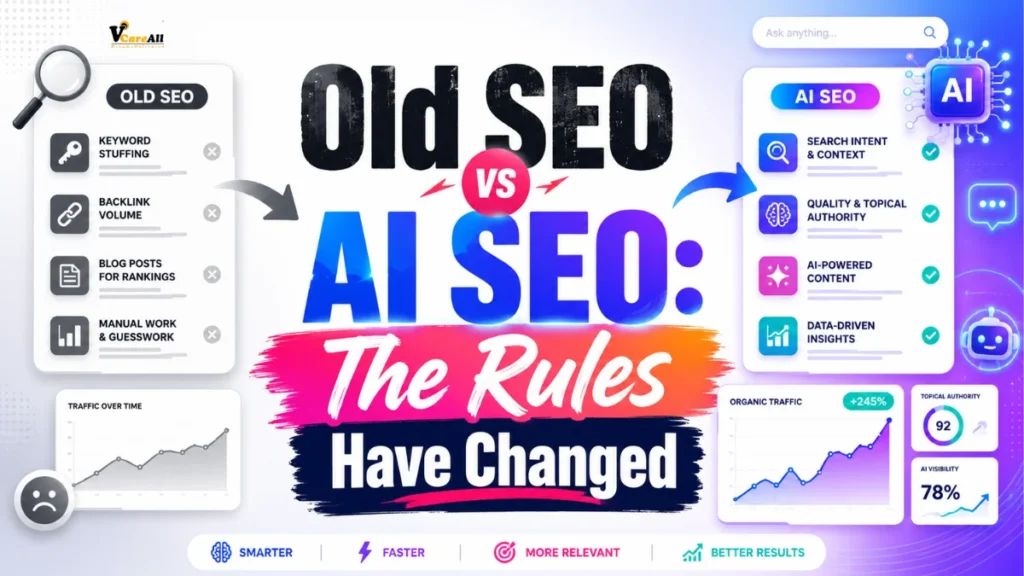
| SEO Area | Old SEO Approach | 2026 AI SEO Approach |
|---|---|---|
| Keywords | Exact keyword repetition | Natural language and search intent |
| Content | Long blogs with basic information | Helpful content with proof, examples, and structure |
| Ranking | Focus only on Google positions | Focus on Google, AI Overviews, AI Mode, and answer engines |
| Traffic | Clicks from blue links | Clicks, citations, brand visibility, and conversions |
| Authority | Backlinks only | E-E-A-T, brand mentions, sources, and author credibility |
| Technical SEO | Meta tags and sitemap | Crawlability, schema, speed, structured data, and clean HTML |
| Measurement | Rankings and traffic | AI visibility, CTR, branded searches, leads, and conversions |
Ready to Win AI SEO?
Learn how ai is changing seo in 2026 and prepare your website for the new search rules.
Build stronger visibility before your competitors catch up.
1. AI Is Turning Search Engines Into Answer Engines
The first major change is that search engines are becoming answer engines.
Earlier, Google mostly showed a list of websites. The user clicked a result and read the answer on a website. Now AI-powered search can summarize the answer directly inside the search result.
For example, if someone searches:
“What is schema markup?”
AI can directly answer:
“Schema markup is structured data added to a webpage to help search engines understand the content.”
For this type of simple query, the user may not need to click a website.
This is a big change for bloggers and businesses. If your content only gives simple definitions, it may get fewer clicks. AI can summarize simple information very quickly.
But this does not mean content is useless. It means basic content is not enough.
To succeed in 2026, your content should include:
| Content Element | Why It Matters |
|---|---|
| Original examples | Shows real understanding |
| Case studies | Builds trust |
| Tables | Makes information easy to scan |
| Screenshots | Proves practical experience |
| Updated data | Shows freshness |
| Expert opinion | Adds uniqueness |
| Templates | Gives users something useful |
| Step-by-step process | Helps readers take action |
AI can summarize a basic answer. But it cannot replace strong experience, original research, real examples, and useful tools as easily.
2. Zero-Click Searches Are Becoming a Bigger Challenge
Zero-click search means the user gets the answer without clicking any website.
This is not completely new. Google has shown featured snippets, knowledge panels, maps, and quick answers for many years. But AI Overviews and AI search summaries make zero-click behavior more powerful because they can answer more complex questions.
Semrush reported that AI Overviews appeared for 6.49% of keywords in January 2025 and rose to nearly 25% in July 2025 before later moving to 15.69%. This shows that AI search visibility is changing quickly and should be monitored regularly.
A 2026 academic study on Google AI Overviews and Wikipedia estimated that AI Overview exposure reduced daily traffic to English Wikipedia articles by around 15%. The effect was stronger for topics where short summaries could satisfy the user’s need.
This does not mean every website will lose 15% traffic. Different industries will see different results. But it does prove one thing clearly: AI answers can reduce clicks for some informational content.

Content Most at Risk
| Content Type | Risk Level | Reason |
|---|---|---|
| Simple definitions | High | AI can answer directly |
| Basic “what is” blogs | High | User may not need to click |
| Generic listicles | Medium-high | Easy to summarize |
| News summaries | Medium | Depends on freshness and authority |
| Product comparisons | Medium | Users may still click for details |
| Case studies | Low-medium | Original data is harder to replace |
| Tools and templates | Low | Users need to interact or download |
| Original research | Low | AI needs strong sources to cite |
What You Should Do
Do not depend only on simple informational articles.
Create content that users want to open, save, compare, download, or use.
Better content types include:
- checklists
- calculators
- comparison pages
- templates
- original research
- case studies
- product reviews with proof
- step-by-step tutorials
- expert guides
- industry reports
In short, AI is reducing the value of basic content and increasing the value of practical content.
how ai is changing seo in 2026
3. GEO Is Becoming Important Alongside SEO
A new term is becoming popular in digital marketing: GEO, or Generative Engine Optimization.
GEO means optimizing your content so AI tools can understand, retrieve, summarize, and possibly cite it.
Traditional SEO helps your content rank in search engines. GEO helps your content appear in AI-generated answers.
But GEO does not replace SEO. It works with SEO.
Google’s own guidance for AI features says site owners should continue following the same fundamentals: make pages crawlable, create helpful content, use structured data where appropriate, and give users a good page experience.
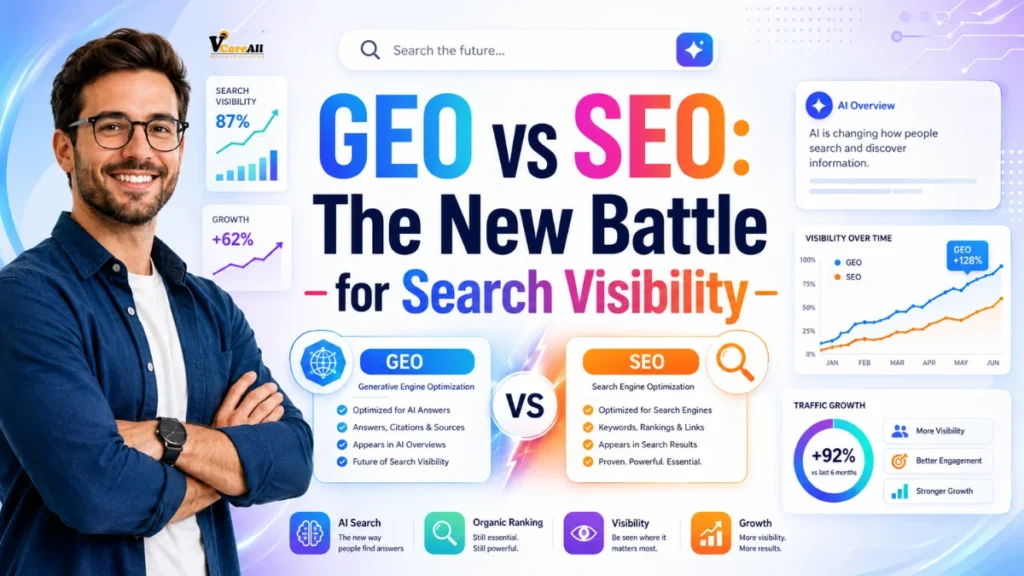
SEO vs GEO
| Feature | SEO | GEO |
|---|---|---|
| Full Form | Search Engine Optimization | Generative Engine Optimization |
| Main Goal | Rank in search results | Appear in AI-generated answers |
| Platforms | Google, Bing, YouTube | AI Overviews, AI Mode, ChatGPT, Gemini, Perplexity |
| Content Style | Keyword and ranking focused | Answer, entity, and trust focused |
| Best Content | Blogs, pages, backlinks | Clear answers, citations, tables, structured content |
| Measurement | Rankings and clicks | AI citations, mentions, visibility, conversions |
How to Make Content GEO-Friendly
Use clear and simple structure.
For example:
Question: What is AI SEO?
Answer: AI SEO is the process of optimizing content so search engines and AI systems can understand, trust, summarize, and recommend it to users.
This style helps both readers and AI systems.
To make content more AI-friendly, use:
- clear headings
- short paragraphs
- direct answers
- tables
- FAQs
- schema markup
- examples
- sources
- author details
- updated dates
Avoid:
- keyword stuffing
- vague claims
- fake case studies
- unsupported statistics
- copied content
- over-promising results
how ai is changing seo in 2026
Don’t Lose Search Traffic
Understand how ai is changing seo in 2026 and protect your website from zero-click searches.
Upgrade your content strategy for AI-powered search results.
4. AI Search Works Differently From Traditional Search
To understand how ai is changing seo in 2026, you need to understand how AI search works at a basic level.
Different tools work differently, but many AI search systems use a process similar to retrieval and synthesis.
In simple words:
- The user asks a question.
- The system understands the meaning of the question.
- It searches or retrieves useful information.
- It selects relevant passages or sources.
- An AI model summarizes the answer.
- It may show citations or links.
This is often connected with retrieval-augmented generation, also called RAG. In simple language, RAG means the AI system retrieves information from outside sources and then uses a language model to create an answer.
This changes SEO because your content may now compete in more than one stage.
| Stage | What Happens | SEO Impact |
|---|---|---|
| Discovery | Search engine finds your page | Technical SEO matters |
| Retrieval | AI finds relevant content | Semantic SEO matters |
| Selection | AI chooses useful sources | E-E-A-T matters |
| Synthesis | AI summarizes information | Clear structure matters |
| Citation | AI links or references sources | Authority matters |
A 2026 academic study found that AI Overview source selection can differ from traditional Google search rankings. In that study, nearly 30% of AI Overview-cited domains did not appear in the co-displayed first-page results, suggesting AI source selection may not be identical to normal organic ranking.
This is very important. Ranking well is still useful, but AI visibility may require additional signals such as clarity, source quality, topical relevance, and trust.
how ai is changing seo in 2026
5. E-E-A-T Is Now More Important Than Ever
E-E-A-T means:
Experience, Expertise, Authoritativeness, and Trustworthiness.
This is extremely important in 2026 because AI tools have made content creation very easy. Anyone can generate a long article quickly. But not every article deserves trust.
Google says its systems are designed to reward helpful, reliable, people-first content. Google also says AI-generated content is not automatically against its guidelines, as long as the content is helpful and not created mainly to manipulate rankings.
So the problem is not AI writing. The problem is low-quality writing.
Weak E-E-A-T Content
Weak content usually has:
- no author name
- no experience
- no sources
- no examples
- no screenshots
- no update date
- no real testing
- no clear purpose
- no balanced discussion
- no transparency
Strong E-E-A-T Content
Strong content includes:
- author bio
- publication date
- last updated date
- trusted citations
- practical examples
- real screenshots
- original insights
- balanced pros and cons
- clear limitations
- transparent disclosure
E-E-A-T Improvement Table
| E-E-A-T Element | Weak Version | Strong Version |
|---|---|---|
| Experience | “AI improves SEO.” | “We tested 20 AI-search queries and recorded which pages were cited.” |
| Expertise | No author details | Author bio with SEO experience |
| Authority | No mentions or citations | Cites Google, research, industry studies |
| Trust | Big claims with no proof | Clear sources, dates, disclaimers, limitations |
Important Tip
Do not add fake case studies.
If you do not have real data, say that clearly. Add a testing section and collect real results over time. Fake numbers may look impressive for a moment, but they damage trust.
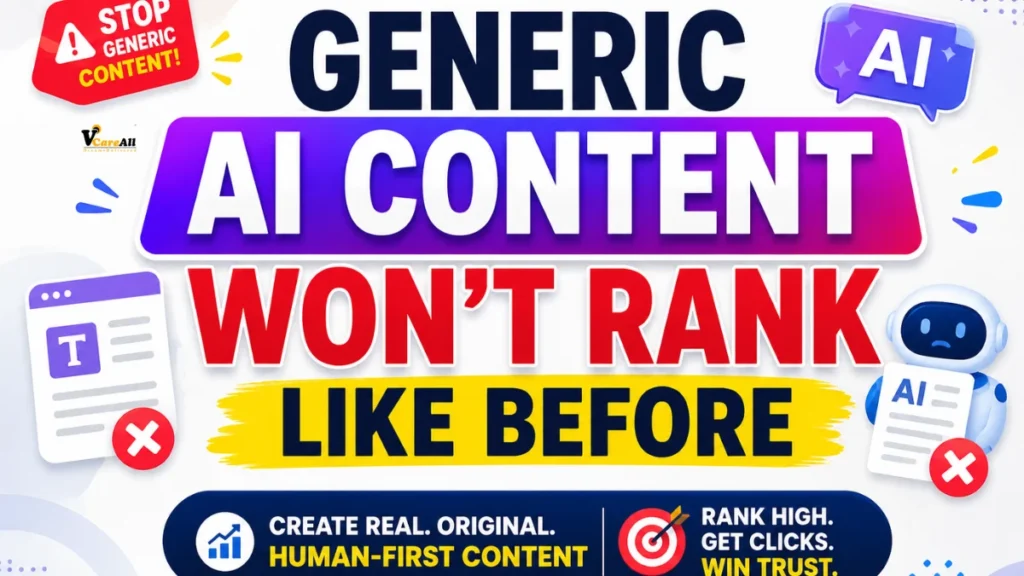
6. Generic AI Content Is Losing Value
AI can write content fast. But fast content is not always good content.
Many websites are publishing similar AI-generated articles with the same structure, same phrases, and same basic advice. This creates a problem: if your article says the same thing as 1,000 other articles, why should Google, AI tools, or users trust your page?
Generic AI content usually has:
- repeated ideas
- no original examples
- no proof
- no strong opinion
- no first-hand experience
- no unique images
- no real screenshots
- no clear author identity
In 2026, content needs human value.
AI can help with:
- topic ideas
- outlines
- grammar
- summaries
- FAQ ideas
- meta descriptions
- content repurposing
But humans should add:
- strategy
- experience
- proof
- examples
- judgment
- brand voice
- real data
- fact-checking
AI Content Workflow
| Step | AI Can Help With | Human Must Add |
|---|---|---|
| Research | Topic ideas | Source checking |
| Outline | Structure | Search intent |
| Draft | First version | Expertise and examples |
| Editing | Grammar | Brand voice |
| SEO | Keyword ideas | Final strategy |
| Publishing | Repurposing | Quality control |
The best content in 2026 will combine AI speed with human experience.
how ai is changing seo in 2026
Future-Proof Your SEO
Discover how ai is changing seo in 2026 and learn what Google’s AI search means for your rankings.
Use smarter content, schema, and E-E-A-T to stay visible.
7. Keyword Research Is Becoming More Intent-Based
Keyword research is still important. But the way we use keywords is changing.
Earlier, many SEO writers repeated the exact keyword again and again. That approach is outdated.
For example, this sounds bad:
how ai is changing seo in 2026 is important because how ai is changing seo in 2026 helps people understand how ai is changing seo in 2026.
This is keyword stuffing. It hurts readability.
A better version is:
Businesses want to understand how ai is changing seo in 2026 because search is moving from simple keyword results to AI-powered answers, summaries, and recommendations.
This is natural and useful.
Old Keyword Strategy vs New Keyword Strategy
| Old SEO | 2026 SEO |
|---|---|
| Repeat exact keyword | Use keyword naturally |
| Focus only on volume | Focus on intent |
| Write for bots | Write for humans and AI |
| One keyword per page | Topic clusters |
| Short search terms | Conversational queries |
| Basic ranking focus | Visibility and conversions |
Related Keywords to Include Naturally
For this blog topic, you can naturally include:
- AI SEO
- SEO in 2026
- AI search optimization
- generative engine optimization
- GEO
- AI Overviews
- Google AI Mode
- zero-click search
- E-E-A-T
- structured data
- schema markup
- semantic SEO
- answer engine optimization
- content quality
- search intent
Do not force them. Use them only where they fit naturally.
8. Structured Data Is Becoming More Useful
Structured data is code that helps search engines understand your page.
It can tell Google:
- this is an article
- this is the author
- this is the publisher
- this is the FAQ section
- this is a product
- this is a review
- this is a software application
Google explains that structured data helps it understand page content and can make pages eligible for search features when used correctly.
For a blog like this, useful schema types include:
| Schema Type | Best Use |
|---|---|
| Article Schema | Main blog post |
| FAQPage Schema | FAQ section |
| Breadcrumb Schema | Navigation |
| Organization Schema | Website or business |
| Person Schema | Author details |
| WebPage Schema | Page identity |
| HowTo Schema | Step-by-step guides |
Recommended Schema Fields
| Field | Why It Matters |
|---|---|
| headline | Shows article title |
| author | Supports trust |
| datePublished | Shows original date |
| dateModified | Shows freshness |
| publisher | Shows brand identity |
| image | Supports rich appearance |
| mainEntityOfPage | Connects schema to the page |
| FAQPage | Structures common questions |
Simple Article Schema Example
<script type="application/ld+json">
{
  "@context": "https://schema.org",
  "@type": "Article",
  "headline": "How AI Is Changing SEO in 2026: New Rules for Success",
  "description": "Learn how AI is changing SEO in 2026, including AI Overviews, GEO, zero-click search, E-E-A-T, schema, and content strategy.",
  "author": {
    "@type": "Person",
    "name": "Add Author Name",
    "url": "Add Author Profile URL"
  },
  "publisher": {
    "@type": "Organization",
    "name": "Add Website Name",
    "logo": {
      "@type": "ImageObject",
      "url": "Add Logo URL"
    }
  },
  "datePublished": "2026-06-04",
  "dateModified": "2026-06-04",
  "mainEntityOfPage": {
    "@type": "WebPage",
    "@id": "Add Final Blog URL"
  }
}
</script>
Do not add schema just for decoration. Make sure the schema matches the real visible content on the page.
how ai is changing seo in 2026
9. Topical Authority Is Stronger Than One Blog Post
One blog post is not enough to become a trusted source.
If your website wants to rank for AI SEO topics, it should cover the topic deeply.
For example, instead of publishing only one article titled How AI Is Changing SEO in 2026, create a full topic cluster.
AI SEO Topic Cluster Example
| Main Topic | Supporting Blog Ideas |
|---|---|
| How AI is changing SEO in 2026 | What is AI SEO? |
| GEO vs SEO | |
| AI Overviews optimization guide | |
| How to optimize content for AI search | |
| Schema markup for AI SEO | |
| Zero-click SEO strategy | |
| AI SEO tools comparison | |
| How to measure AI search visibility | |
| E-E-A-T checklist for AI content | |
| Future of SEO after AI |
This helps Google and AI systems understand that your website has depth.
Internal Linking Strategy
From this blog, link to related pages such as:
- AI SEO checklist
- technical SEO audit guide
- schema markup guide
- content refresh checklist
- Google Search Console guide
- SEO content calendar
- SaaS SEO strategy
- affiliate SEO strategy
Internal linking helps users and search engines move through your content. It also builds topical authority.
how ai is changing seo in 2026
Rank Smarter with AI
Explore how ai is changing seo in 2026 and see why old SEO tricks are no longer enough.
Create helpful, trusted, and AI-friendly content that search engines understand.
10. Brand Mentions Are Becoming More Powerful
AI systems do not only look at your website. They may also understand your brand from third-party mentions.
These mentions can come from:
- YouTube
- Quora
- review sites
- directories
- podcasts
- guest posts
- industry blogs
- comparison articles
If your brand is described differently everywhere, AI systems may get confused.
For example, weak brand messaging sounds like this:
We help businesses grow online.
Strong brand messaging sounds like this:
MailerRocket is an email marketing and automation platform that helps businesses create campaigns, improve deliverability, write emails with AI, manage branded links, and grow customer engagement.
This is more specific and easier to understand.
Brand Consistency Checklist
| Platform | What to Keep Consistent |
|---|---|
| Website | Main value proposition |
| About page | Company story |
| Founder and company positioning | |
| YouTube | Educational content topics |
| X/Twitter | Short brand messaging |
| Directories | Product description |
| Review sites | Feature and category details |
| Guest posts | Expert positioning |
In 2026, your website is not your only SEO asset. Your brand reputation across the web also matters.
how ai is changing seo in 2026
11. AI Is Changing SaaS SEO
For SaaS companies, AI search creates both risk and opportunity.
The risk is simple: AI can answer basic educational queries without sending users to your website.
For example:
“What is email automation?”
AI may answer this directly.
But users still need deeper information before buying software. They want to compare features, pricing, use cases, screenshots, reviews, integrations, and alternatives.
So SaaS SEO should focus strongly on decision-stage content.
SaaS SEO Content Plan
| Funnel Stage | Content Type | Example |
|---|---|---|
| Awareness | Educational blog | What is email automation? |
| Interest | Strategy guide | How to improve email open rates |
| Consideration | Comparison page | MailerRocket vs Mailchimp |
| Decision | Pricing page | Email marketing software pricing |
| Conversion | Case study | How a creator improved campaign engagement |
| Retention | Help article | How to set up an email automation |
SaaS Pages That Matter in 2026
- alternative pages
- comparison pages
- use-case pages
- industry pages
- integration pages
- pricing pages
- template libraries
- case studies
- onboarding guides
- help center articles
AI may reduce clicks on basic content, but users still click when they need to make a decision.
12. AI Is Changing Affiliate SEO
Affiliate SEO is also changing.
Many old affiliate websites used copied product descriptions, aggressive CTAs, and generic review content. That is becoming weaker.
In 2026, affiliate content should be more honest and experience-based.
A strong affiliate review should include:
- who the product is for
- who should avoid it
- real screenshots
- pricing details
- pros and cons
- feature explanation
- alternatives
- refund policy
- risk disclosure
- FAQs
- comparison table
Weak Affiliate Review
This is the best product. Buy now before the price increases.
Strong Affiliate Review
This product may be useful for beginners who want a simple setup and quick launch. However, it may not be ideal for advanced teams that need deep analytics or custom integrations. Before buying, compare the pricing, features, support, and refund policy.
This is more trustworthy because it is balanced.
Affiliate sites that show real testing and clear limitations will have a better chance of building trust.
how ai is changing seo in 2026
Beat the AI Search Shift
Learn how ai is changing seo in 2026 and adapt your blog before traffic starts dropping.
Turn AI search changes into a powerful growth opportunity.
13. AI Is Changing Local SEO
AI is also changing local search.
When people search for local businesses, AI can summarize reviews, compare options, and help users choose faster. But local SEO still depends heavily on trust, location, reviews, photos, and service details.
For local businesses, Google Business Profile is still very important.
Local SEO Checklist for 2026
| Task | Why It Matters |
|---|---|
| Complete business profile | Helps users understand your services |
| Add correct phone and address | Builds trust |
| Add real photos | Improves engagement |
| Collect reviews | Supports credibility |
| Reply to reviews | Shows activity |
| Add service details | Improves relevance |
| Post regular updates | Keeps profile fresh |
| Use local keywords | Helps local visibility |
Example:
Weak:
Digital marketing agency.
Strong:
Digital marketing agency in Delhi helping small businesses with SEO, Google Ads, social media marketing, and website growth.
Specific wording helps both users and search systems.
how ai is changing seo in 2026
14. AI Is Changing SEO Measurement
Earlier, SEO success was mostly measured by rankings and organic traffic.
Now that is not enough.
A page can rank well but still get fewer clicks because AI answers appear above traditional results.
So you should track more signals.
Modern SEO Metrics
| Metric | Why It Matters |
|---|---|
| Organic clicks | Shows actual traffic |
| Impressions | Shows search visibility |
| CTR | Shows title and snippet performance |
| Keyword rankings | Shows position changes |
| AI Overview presence | Shows AI search impact |
| AI citation visibility | Shows whether your site is referenced |
| Branded searches | Shows brand demand |
| Leads | Shows business value |
| Conversions | Shows revenue impact |
| Engagement | Shows content quality |
Manual AI Visibility Tracking Table
You can test important queries once a month.
| Query | Google AI Overview? | Your Site Cited? | Competitor Cited? | Notes |
|---|---|---|---|---|
| how ai is changing seo in 2026 | Yes/No | Yes/No | Yes/No | Add observation |
| AI SEO checklist | Yes/No | Yes/No | Yes/No | Add observation |
| GEO vs SEO | Yes/No | Yes/No | Yes/No | Add observation |
| AI Overviews SEO | Yes/No | Yes/No | Yes/No | Add observation |
Do not guess. Test and record.
This will give you real experience and improve your future content.
15. Practical AI SEO Strategy for 2026
Here is a simple strategy you can follow.
Step 1: Audit Existing Content
Find pages that:
- lost traffic
- have low CTR
- are outdated
- have no author bio
- have no schema
- have no examples
- have no internal links
- have weak introductions
- have thin answers
Step 2: Improve Weak Pages
Add:
- updated information
- direct answer section
- trusted sources
- tables
- FAQs
- author bio
- screenshots
- examples
- internal links
- schema markup
Step 3: Build Topic Clusters
Choose one main topic and create supporting articles.
Example:
Main topic: AI SEO
Supporting topics:
- What is AI SEO?
- AI SEO checklist
- GEO vs SEO
- AI Overviews optimization
- Schema for AI SEO
- Content strategy after AI Overviews
- Technical SEO for AI search
- AI SEO tools comparison
Step 4: Add Real Experience
Add a testing section.
Example:
Testing Date: Add date
Queries Tested: Add number
Platforms Tested: Google AI Overviews, Google AI Mode, ChatGPT Search, Perplexity, Gemini
Method: Search each query and record which sources appear.
Step 5: Improve Brand Trust
Add:
- About page
- contact page
- author profile
- editorial policy
- privacy policy
- real social profiles
- customer testimonials
- third-party mentions
Step 6: Measure Business Results
Do not only measure traffic.
Also measure:
- leads
- signups
- demo requests
- sales
- newsletter subscribers
- branded searches
- conversion rate
SEO should bring business growth, not just pageviews.
how ai is changing seo in 2026
AI SEO Checklist for 2026
| Checklist Item | Status |
|---|---|
| Focus keyword used naturally | ☐ |
| Title includes main keyword | ☐ |
| Meta description written | ☐ |
| Introduction answers user intent | ☐ |
| Author bio added | ☐ |
| Published date added | ☐ |
| Last updated date added | ☐ |
| Trusted sources cited | ☐ |
| Tables included | ☐ |
| FAQs included | ☐ |
| Conclusion placed before FAQs | ☐ |
| Article schema added | ☐ |
| FAQ schema added | ☐ |
| Internal links added | ☐ |
| Images optimized | ☐ |
| Page speed checked | ☐ |
| Mobile readability checked | ☐ |
| Limitations section added | ☐ |
| Real examples added | ☐ |
Common AI SEO Mistakes to Avoid
| Mistake | Why It Hurts |
|---|---|
| Publishing generic AI content | No unique value |
| Keyword stuffing | Bad readability |
| Fake case studies | Destroys trust |
| No author bio | Weak E-E-A-T |
| No sources | Weak credibility |
| No update date | Looks outdated |
| Ignoring technical SEO | Poor crawlability |
| No internal links | Weak topical authority |
| Only tracking rankings | Misses AI visibility |
| Over-promising results | Reduces trust |
When AI SEO May Not Work Well
AI SEO is useful, but it does not work like magic.
It may not help much in some situations.
| Situation | Why AI SEO May Not Help |
|---|---|
| Very new website | Low authority |
| Thin affiliate site | Low trust |
| Poor technical SEO | Content may not be crawled properly |
| No real examples | Content looks generic |
| Very local searches | Maps and reviews may matter more |
| Highly visual shopping queries | Product images and prices may dominate |
| Over-optimized content | Human readers may lose trust |
The goal is not to write robotic content for AI.
The goal is to create content that is clear for AI and valuable for humans.
how ai is changing seo in 2026
Upgrade Your SEO Strategy
Understand how ai is changing seo in 2026 and improve your content for AI Overviews and GEO.
Make your website easier for both users and AI systems to trust.
Conclusion: how ai is changing seo in 2026
AI is changing SEO in 2026, but SEO is not dead.
The real change is that search is becoming more intelligent, more conversational, and more answer-focused. Google AI Overviews, AI Mode, ChatGPT, Gemini, Perplexity, and other AI tools are changing how people discover information.
The keyword how ai is changing seo in 2026 represents this major shift.
In the old SEO world, many websites could grow with long articles, keyword placement, and backlinks. In the new SEO world, that is not enough. Content must be helpful, trusted, structured, updated, and backed by real experience.
AI can reduce clicks for simple informational content. But it can also create new opportunities for websites that publish useful guides, original research, case studies, comparison pages, templates, tools, and expert content.
To win in 2026, focus on:
- helpful content
- clear structure
- E-E-A-T
- schema markup
- topical authority
- brand mentions
- real examples
- updated information
- user experience
- conversion-focused content
Do not treat AI SEO as a shortcut.
Treat it as a quality upgrade.
The best SEO strategy for 2026 is:
Write for humans, structure for AI, and prove every important claim.
If you follow this approach, AI search can become an opportunity instead of a threat.
how ai is changing seo in 2026
FAQs: How AI Is Changing SEO in 2026
1. How AI is changing SEO in 2026?
AI is changing SEO in 2026 by turning search engines into answer engines. Search platforms now use AI to summarize answers, understand complex questions, and recommend sources. This means websites need helpful content, strong structure, trust signals, schema markup, and real experience.
2. Is SEO dead because of AI?
No, SEO is not dead. SEO is evolving. Traditional SEO basics like crawlability, keyword research, internal linking, backlinks, and technical optimization still matter. But now websites also need AI visibility, E-E-A-T, brand authority, and content that can be trusted by both people and AI systems.
3. What is GEO in SEO?
GEO means Generative Engine Optimization. It is the process of optimizing content so AI-powered tools can understand, retrieve, summarize, and cite it. GEO works with SEO and does not replace it.
4. Will AI Overviews reduce website traffic?
AI Overviews can reduce traffic for some informational searches because users may get answers directly on the search page. A 2026 study on Wikipedia estimated around a 15% daily traffic reduction for exposed English Wikipedia articles, but the effect depends on topic, intent, and website type.
5. What type of content works best in AI SEO?
Content that works best in AI SEO is clear, helpful, experience-based, and well-structured. Strong content includes direct answers, examples, tables, FAQs, trusted sources, author details, screenshots, original insights, and practical steps.
6. Can AI-written content rank on Google?
Yes, AI-written content can rank if it is helpful, accurate, original, and created for people. Google says it focuses on content quality rather than whether content was produced by AI or humans. However, low-quality AI content created mainly to manipulate rankings can perform poorly.
7. How can I make my blog AI-friendly?
You can make your blog AI-friendly by using clear headings, simple language, direct answers, short paragraphs, tables, FAQ sections, schema markup, internal links, author bios, updated dates, and trusted citations. Add real examples whenever possible.
8. Does schema markup help AI SEO?
Schema markup helps search engines understand your content more clearly. It does not guarantee ranking or AI citation, but it supports content clarity. Useful schema types include Article, FAQPage, BreadcrumbList, Organization, Person, Product, Review, and SoftwareApplication schema.
9. What is the biggest SEO mistake in 2026?
The biggest SEO mistake in 2026 is publishing generic AI-generated content without real value, proof, sources, or expertise. Other major mistakes include keyword stuffing, fake case studies, no author bio, no update date, poor technical SEO, and ignoring AI search visibility.
10. What is the best SEO strategy for 2026?
The best SEO strategy for 2026 is to combine traditional SEO with AI search optimization. Create helpful content, build topic clusters, improve E-E-A-T, add schema markup, use trusted sources, earn brand mentions, improve technical SEO, and track both organic traffic and AI visibility.
how ai is changing seo in 2026